If you invest in the Indian stock market, there are questions worth asking before putting your money into any stock-
From which sector does the stock belong?
Is that sector worth being in right now?
As industries develop as per technological advancements, government initiatives, changing consumer preferences, and global trends, certain stock market sectors in India have potentially emerged as key growth drivers.
Analysing sector-wise performance of indian stock market may influence your portfolio returns. In this blog, we will explore some of the leading sectors in India that are worth investing in 2026.
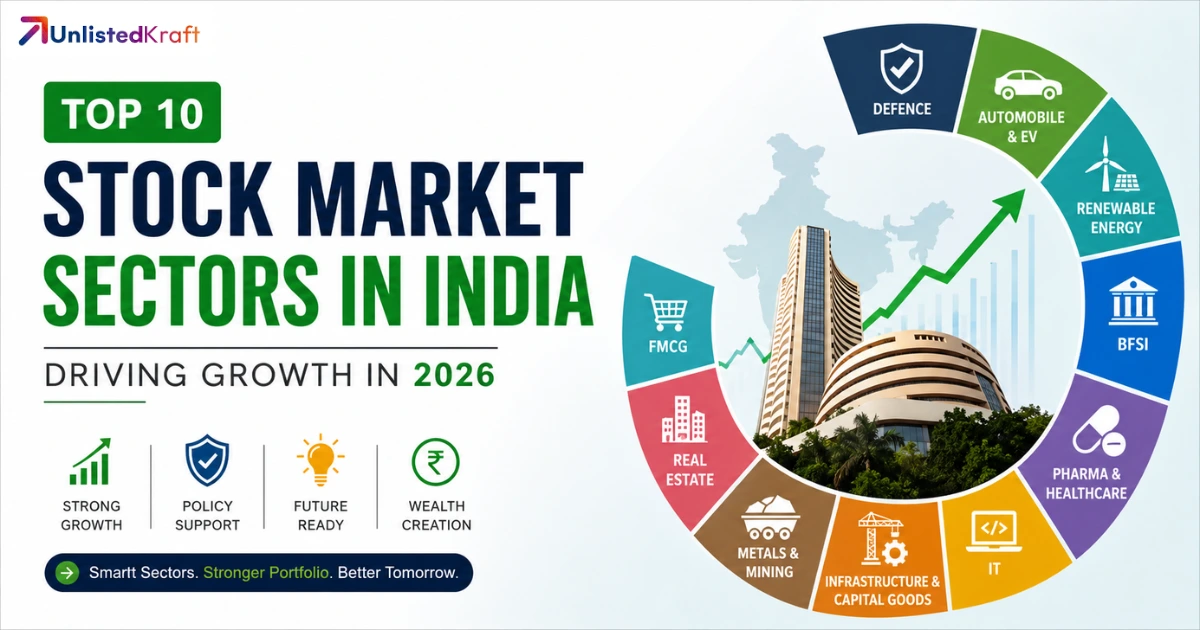
Top 10 Stock Market Sectors in India to Watch in 2026
India's stock market spans over a large number of sectors and industries. While every sector has its own benefits and challenges regarding investment, there is no uniform approach as to which ones are the best. Listed below are a few of the top performers in 2026 based on their performance, policy support, and growth potential. Here are the top 10 sectors in indian stock market that matter to your portfolio.
Sector
Key Growth Driver
Defence
Rising defence budget, Make in India initiative
Automobile & EV
EV adoption, Government incentives
Renewable Energy
500 GW target, Green energy push
BFSI
Credit growth, Digital lending
Pharmaceuticals & Healthcare
Generic medicine exports, Ayushman Bharat Initiative
Information Technology
AI, cloud computing
Infrastructure & Capital Goods
Govt capital expenditure, PM Gati Shakti Scheme
Metals & Mining
Infrastructure demand, EV supply chain
Real Estate
Urbanisation, Rising incomes
FMCG
Rural demand revival, Quick commerce
Let’s explore these in more detail
1. Defence Sector
The Defence sector has emerged as one of the most closely watched sectors in India. In recent years, the sector has witnessed some great moves, such as - Make in India initiatives
Rising defence budget allocations
Increasing defence exports
Indigenous manufacturing programs
As per reports, India's total defence allocation for FY26 -27 is around ₹7.85 lakh crore, a 15.2% increase year-on-year (FY 2025-26). The DRDO budget was also raised to ₹29,100 crore from ₹26,816.82 crore in FY 2025–26. With the growing defence exports and policy support, the sector is set to offer long-term growth potential. Some of the well-known and actively tracked companies in the Defence sector are Hindustan Aeronautics Limited (HAL), Bharat Electronics Limited (BEL), Bharat Dynamics Limited (BDL) and Cochin Shipyard.
2. Automobile & Electric Vehicles (EVs)
With the rising consumer demand and electric vehicle subsidies, the automobile sector in India has evolved significantly. EV adoption in India is growing rapidly across two-wheelers, passenger cars, and commercial transport. The growth is closely associated with:
Government incentives
Rising vehicle ownership
Growth in premium vehicle segments
Rapid adoption of Electric Vehicles
India has one of the largest automobile markets in the world. Around 7% of India’s total GDP accounts for the automobile sector, and the ongoing shift towards electric vehicles is adding a new layer of growth to an already large industry. With these advancements, the sector is experiencing significant capital investment and policy backing, making it worth considering for those looking at long-term wealth creation. Top Companies to Watch in this sector are Tata Motors, Mahindra & Mahindra (M&M), Bajaj Auto, Maruti Suzuki, etc.
3. Renewable Energy
India’s energy sector has transformed massively in the past few years and ranks third globally in renewable energy capacity. The country has significantly expanded its renewable energy capacity, supported by government initiatives and private sector investments. The sector seeks major investments in solar power, wind energy, green hydrogen and battery storage to accomplish the target of producing 500 GW of renewable energy capacity by 2030. The top companies to monitor in this sector are:
NTPC Green Energy: India's largest state-owned renewable energy company
Tata Power: Diversified power with a growing clean energy portfolio
Adani Green Energy: India's largest renewable energy company by installed capacity
Suzlon Energy: Wind energy turbine manufacturer and project developer
The BFSI sector is also worth considering when we talk about the top stock market sectors list in India. It is one of the largest and most influential sectors in the Indian stock market.
India’s BFSI sector accounts for almost 27% of India’s GDP compared to just 6% two decades ago. As per a report by Business Standard, India’s BFSI sector has grown 50 times in market capitalisation over the past two decades, reaching ₹91 lakh crore in 2025 from ₹1.8 lakh crore in 2005, growing at a CAGR of 22%.
The growth is driven by several factors, such as:
Improved asset quality
Healthy credit growth supported by RBI's rate cuts in 2025
Rising insurance penetration across urban and rural India
The pharmaceutical and healthcare sector of India is the world's largest supplier of generic medicines by volume, accounting for approximately 20% of the global supply. As per publicly available reports, India's pharma revenue is projected to reach $130–140 billion by 2030, and the key reasons driving this growth will be biotech innovation and rising domestic healthcare consumption supported by schemes like Ayushman Bharat.
From software services and digital transformation to cloud computing and artificial intelligence, Indian IT companies significantly contribute to India's GDP and remain one of the largest sources of foreign exchange earnings. The sector is reportedly expected to reach a target of $350 billion in revenue by 2026 due to higher-value work with:
The government's continued push in India’s infrastructure sector includes capital expenditure covering roads, railways, ports, airports, and urban infrastructure. The government of India has projected a sum of ₹11 lakh crore towards capital expenditure, and frameworks like PM Gati Shakti and the National Infrastructure Pipeline. This creates multi-year revenue visibility for companies operating in this space.
India has been a noble supplier of metal products for both domestic and global needs. Lately, India's own infrastructure growth, including roads, railways, defence manufacturing, and housing, has created consistent internal demand for steel, aluminium, and copper. The sector is particularly interesting from an investment perspective because the demand is coming from multiple directions at once.
Domestic copper consumption is expected to grow 10-12% annually over the next two years.
The steel demand is projected to rise by around 9% in 2025–26.
As more people are moving to cities and incomes are rising, both residential and commercial real estate projects are seeing strong demand. This surge in demand will help the real estate companies scale well in the industry, report strong sales, grow revenues, and expand project pipelines year after year. This may position the real estate sector as one of the most active investment sectors in the country.
The FMCG sector is the sector that keeps everyday India running, from soaps and shampoos to packaged foods and beverages. The sector has seen massive growth in the past few years due to growth in income, change in lifestyles and growing urbanisation.
For investors, FMCG is often a stable, lower-risk sector as it generally does not get adversely affected by unfavourable market conditions. The introduction of quick commerce has surged the demand and has made the sector a potential investment choice among investors.
India's economic growth in 2026 is shaped by a mix of traditional leaders and emerging industries. Banking, information technology, healthcare, and FMCG continue to provide stability, while defence, renewable energy, capital goods, and infrastructure are assisted by strong policy support and investment activity. Understanding the different sectors in the Indian stock market before investing is a strong foundation for building a portfolio that can deliver strong returns over the long run.
Frequently Asked Questions
1. What are the best performing sector in stock market in 2026?
The top 10 stock market sectors in India in 2026 are Defence, Automobile & EV, Renewable Energy, BFSI, Pharmaceuticals & Healthcare, Information Technology, Infrastructure & Capital Goods, Metals & Mining, Real Estate, and FMCG.
2. Which are the best stocks to buy for long-term investment in India in 2026?
For long-term investors, sectors like Renewable Energy, Healthcare, and Infrastructure are generally recommended.
3. How many sectors are there in the Indian stock market?
India's NSE and BSE classify stocks across a large number of sectors and sub-sectors. Broadly, the Indian stock market is divided into 11 major sectors under the GICS (Global Industry Classification Standard) framework, which are further classified into over 90 sub-sectors and industries.
4. Is it better to invest in one sector or diversify across multiple sectors?
Diversification is very important in investment. Most financial advisors suggest spreading investments across 3–4 sectors to balance risk and returns.
5. How should I do a sector analysis in stock market before investing?
Check a few of the key things, like government policy support, demand outlook, earnings growth of companies in that sector, valuation levels, and global factors that could impact it.
6. Should I invest in emerging sectors like EV and renewable energy in 2026?
Emerging sectors like EV and renewable energy offer long-term growth potential backed by strong policy support and global trends. However, they also come with higher uncertainty compared to established sectors. Complete research and professional advice are recommended before investing.
Author: Komal Bhatt
Komal Bhatt is a finance content writer at InvestKraft, specialising in well-researched articles on financial products, stock markets, and investment opportunities, with a particular focus on unlisted shares.
She holds a Master’s degree in Commerce from the University of Delhi, which gives her a solid academic foundation in finance and business. With over three years of hands-on experience in creating digital finance content, Komal has developed a clear understanding of investor needs through her work on wealth management, NISM certification programs, and market education materials.
Komal is passionate when it comes to breaking down complex financial concepts into simple, accurate and actionable insights. Her goal is to help everyday investors understand markets better and make more informed decisions based on reliable, research-backed information.
 amit@unlistedkraft.in
 +91-8796470040
 +91-8796470040














 +91-9599071664
 amit@unlistedkraft.in