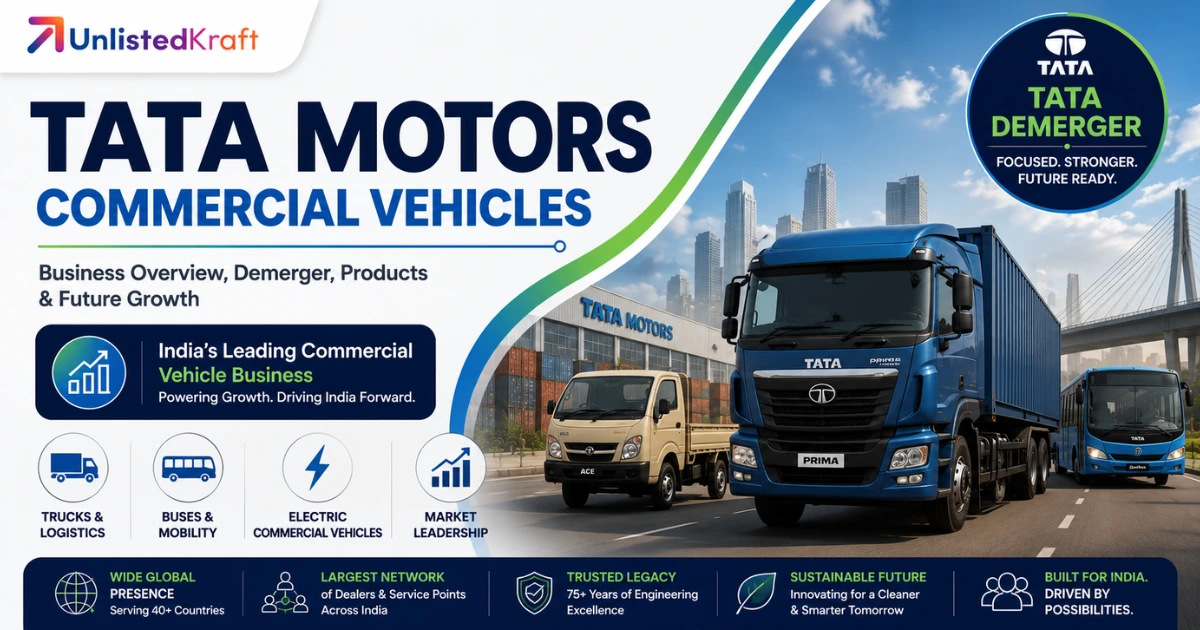
India's commercial vehicle industry plays a vital role in supporting the country's logistics, infrastructure, mining, construction, public transportation, and e-commerce sectors. As one of the largest commercial vehicle manufacturers in India, Tata Motors has built a strong legacy through its extensive portfolio of trucks, buses, pickups, and defence mobility solutions.
Following the Tata Motors demerger, the commercial vehicle business was separated into Tata Motors Commercial Vehicles Ltd. (TMLCV), allowing it to operate as an independent business with dedicated management, focused capital allocation, and a clear long-term growth strategy. The restructuring enables the commercial vehicle business to respond more effectively to industry trends while continuing its leadership in domestic and international markets.
Today, TMLCV serves millions of businesses across India through one of the country's largest dealer and service networks. From small businesses requiring last-mile delivery vehicles to large logistics operators managing nationwide fleets, the company offers mobility solutions across every commercial vehicle category.
Table of Contents
What is Tata Motors Commercial Vehicles Ltd. (TMLCV)?
Company Snapshot
History & Evolution
Company Timeline
Tata Motors Demerger Explained
Why Was TMLCV Created?
Business Model
Revenue Streams
Product Portfolio
Electric Commercial Vehicle Business
What is Tata Motors Commercial Vehicles Ltd. (TMLCV)?
Tata Motors Commercial Vehicles Ltd. (TMLCV) is the dedicated commercial vehicle business that emerged following the demerger of Tata Motors. The company focuses exclusively on designing, manufacturing, and marketing commercial mobility solutions, including trucks, buses, pickups, small commercial vehicles, defence vehicles, and connected fleet services.
By separating the commercial vehicle operations from the passenger vehicle business, TMLCV can pursue an independent strategy focused on freight transportation, public mobility, infrastructure development, fleet digitization, and sustainable commercial transportation. The company serves multiple industries including:
Logistics
Infrastructure
Construction
Mining
Agriculture
E-commerce
Passenger Transportation
Defence
Municipal Services
With decades of manufacturing expertise and one of India's widest commercial vehicle portfolios, TMLCV remains a key contributor to the country's transportation ecosystem.
The commercial vehicle business has been at the heart of Tata Motors since its inception. Over the decades, the company has played a significant role in India's industrial growth by introducing vehicles that cater to freight transportation, passenger mobility, and specialized applications.
Beginning with collaborations in heavy vehicle manufacturing, Tata Motors gradually expanded into medium and light commercial vehicles, buses, pickups, defence mobility, and electric commercial vehicles.
Today, the business is recognized for:
India's largest truck portfolio
Leading bus manufacturing capabilities
Last-mile mobility solutions
Defence vehicle expertise
Connected fleet technologies
Electric commercial vehicles
This long-standing experience has established TMLCV as one of the most trusted commercial vehicle manufacturers in the country.
Company Timeline
Year
Milestone
1945
Tata Engineering and Locomotive Company (TELCO) established
1954
Partnership with Daimler-Benz to manufacture commercial vehicles in India
1986
Launch of the iconic Tata 407 light commercial vehicle
2005
Launch of Tata Ace, creating the mini-truck segment
2012
Introduction of Prima premium truck range
2017
Expansion of connected fleet technologies
2022
Strengthened electric commercial vehicle portfolio
2024
Tata Motors Board approves demerger of PV and CV businesses
2025
Shareholders and regulatory authorities approve the restructuring
2025 Onwards
Commercial vehicle business operates independently as TMLCV
The separation allows both companies to pursue independent growth strategies while enabling investors to better understand the performance of each business.
Why Was TMLCV Created?
Commercial vehicles operate in a completely different business environment compared to passenger vehicles.
The demand for trucks and buses depends on factors such as:
Economic growth
Infrastructure spending
Freight movement
Government policies
Logistics demand
Construction activity
Industrial production
Creating TMLCV as a dedicated commercial vehicle company enables management to respond more effectively to these market dynamics.
Key Objectives
Independent strategic direction
Faster decision-making
Better capital allocation
Improved operational efficiency
Dedicated investment in commercial mobility
Stronger customer focus
Enhanced shareholder value
Business Model
TMLCV follows a diversified business model that extends beyond manufacturing trucks and buses.
The company generates revenue from vehicle sales, after-sales services, spare parts, fleet management solutions, financing partnerships, and digital mobility platforms.
Major Business Segments
Segment
Description
Heavy Commercial Vehicles
Long-haul freight transportation
Intermediate & Light Commercial Vehicles
Regional cargo movement
Small Commercial Vehicles
Last-mile logistics
Pickups
Rural & urban transportation
Buses
Public & private passenger transport
Defence Vehicles
Military logistics & specialized vehicles
Fleet Solutions
Connected fleet management
After-Sales Services
Maintenance & repairs
Genuine Spare Parts
Replacement components
This diversified model enables TMLCV to serve customers across multiple industries while reducing dependence on any single vehicle category.
Revenue Streams
Commercial vehicle sales remain the primary source of revenue, but the company also benefits from recurring income through services and fleet solutions.
Revenue Source
Description
Truck Sales
Heavy, Medium & Light Commercial Vehicles
Bus Sales
School, Staff, City & Intercity Buses
Pickup Sales
Tata Yodha, Intra & other utility vehicles
Defence Contracts
Military mobility solutions
Genuine Spare Parts
OEM replacement parts
After-Sales Service
Maintenance & repairs
Connected Fleet Solutions
Fleet telematics & digital services
Financing Partnerships
Vehicle financing support
The increasing contribution from services and digital solutions helps strengthen customer retention and create recurring revenue opportunities.
Product Portfolio
TMLCV offers one of the broadest commercial vehicle portfolios in India.
Heavy Commercial Vehicles
Designed for long-distance freight transportation and heavy-duty applications.
Popular product families include:
Prima
Signa
LPT Series
Intermediate & Light Commercial Vehicles (ILCV)
These vehicles cater to regional distribution, industrial transportation, and urban logistics.
Key models include:
Ultra Series
LPT Light Trucks
Small Commercial Vehicles (SCVs)
Small commercial vehicles are widely used for last-mile delivery and small business transportation.
Popular models include:
Tata Ace
Tata Intra
Tata Yodha
Passenger Transportation
The company manufactures buses for multiple applications:
City Transport
School Transportation
Staff Transportation
Tourism
Intercity Travel
Defence Mobility
TMLCV also develops specialized vehicles for defence and government applications.
These include:
Logistics Vehicles
Tactical Mobility Vehicles
Troop Carriers
Specialized Defence Platforms
Product Portfolio Table
Category
Popular Products
Heavy Trucks
Prima, Signa, LPT
Intermediate Trucks
Ultra Series
Small Commercial Vehicles
Ace, Intra, Yodha
Pickups
Yodha Pickup
Buses
Starbus, Ultra Bus
Defence Vehicles
Tactical & Logistics Vehicles
Electric Commercial Vehicle (EV) Business
Electric mobility is becoming increasingly important in the commercial vehicle industry, particularly for urban transportation and last-mile delivery.
TMLCV is expanding its presence in electric commercial vehicles through buses and cargo vehicles that support sustainable transportation.
Key Focus Areas
Electric buses
Electric cargo vehicles
Fleet electrification
Connected mobility
Charging ecosystem partnerships
Sustainable logistics
EV Portfolio
EV Category
Application
Electric Buses
Public Transportation
Electric Cargo Vehicles
Last-Mile Delivery
Electric Fleet Solutions
Urban Logistics
The company's EV strategy aligns with India's transition toward cleaner transportation and lower-emission commercial mobility solutions.
Key Takeaways
TMLCV is the dedicated commercial vehicle business following the Tata Motors demerger.
The company serves industries such as logistics, construction, mining, defence, public transport, and e-commerce.
It has one of India's most diversified commercial vehicle portfolios.
Beyond vehicle manufacturing, TMLCV generates revenue from services, spare parts, fleet management, and digital mobility solutions.
Electric commercial vehicles and connected fleet technologies are expected to be major growth drivers in the coming years.
Manufacturing Facilities
Tata Motors Commercial Vehicles Ltd. (TMLCV) operates one of India's largest commercial vehicle manufacturing networks. Its facilities produce heavy trucks, light commercial vehicles (LCVs), buses, pickups, defence vehicles, engines, and advanced powertrain systems. These plants support both domestic demand and exports, ensuring efficient production and timely delivery across various customer segments.
The company continues to invest in automation, digital manufacturing, quality control, and sustainability initiatives to improve productivity and operational efficiency.
Major Manufacturing Facilities
Manufacturing Plant
State
Primary Products
Jamshedpur
Jharkhand
Heavy & Medium Commercial Vehicles
Pune
Maharashtra
Trucks, Pickups, Powertrains
Lucknow
Uttar Pradesh
Buses & Defence Vehicles
Dharwad
Karnataka
Small Commercial Vehicles
Pantnagar
Uttarakhand
Pickups & Small Commercial Vehicles
These strategically located facilities help TMLCV optimize logistics, strengthen its supply chain, and efficiently serve customers across India and export markets.
Research & Development (R&D)
Innovation remains a key pillar of TMLCV's long-term strategy. The company invests significantly in research and development to build safer, more fuel-efficient, connected, and environmentally friendly commercial vehicles.
Its engineering teams work on advanced technologies that improve fleet productivity while reducing operating costs for customers.
Key R&D Focus Areas
Focus Area
Objective
Electric Commercial Vehicles
Expand zero-emission mobility solutions
Hydrogen & Alternative Fuels
Develop future-ready commercial vehicles
Connected Fleet Technology
Improve fleet efficiency and monitoring
Advanced Safety Systems
Enhance driver and passenger safety
Powertrain Development
Improve fuel efficiency and performance
Vehicle Digitalization
Smart diagnostics and predictive maintenance
Leadership & Management
TMLCV is led by an experienced management team with expertise in commercial vehicles, engineering, manufacturing, logistics, and business strategy.
The leadership team focuses on operational excellence, product innovation, customer-centric solutions, and sustainable growth.
The management team is responsible for expanding market leadership while accelerating the transition towards cleaner and smarter commercial mobility.
Corporate Governance
As part of the Tata Group, TMLCV follows high standards of corporate governance and ethical business practices.
Its governance framework emphasizes:
Transparency
Board independence
Risk management
Regulatory compliance
SustainabilityESG reporting
Stakeholder value creation
Strong governance practices enhance investor confidence and support long-term business resilience.
Shareholding Structure
Following the Tata Motors demerger, shareholders continue to hold an economic interest in both the passenger vehicle and commercial vehicle businesses, as per the approved Scheme of Arrangement.
Entity
Business Focus
Tata Motors Passenger Vehicles Ltd. (TMPV)
Passenger Vehicles, EVs & Jaguar Land Rover
Tata Motors Commercial Vehicles Ltd. (TMLCV)
Trucks, Buses, Pickups, Defence & Fleet Mobility
This separation enables each company to focus on its own strategic priorities while improving financial transparency.
Financial Performance
The commercial vehicle business has demonstrated resilience through industry cycles, supported by demand from infrastructure, mining, logistics, construction, and public transportation sectors.
Key growth drivers include:
Strong MHCV demand
Fleet replacement
Infrastructure investments
Government spending
Export opportunities
Digital fleet solutions
Financial Highlights
Update this table with the latest audited FY2026 standalone figures from the TMLCV Annual Report or Investor Presentation before publishing.
Financial Metric
FY2025
FY2026
YoY Growth
Revenue (Sales)
₹76,035 Cr
₹83,854 Cr
10.30%
Operating Profit
₹8,204 Cr
₹10,022 Cr
22.20%
Operating Margin (OPM)
10.80%
12.00%
1.2 pp
Profit Before Tax
₹4,087 Cr
₹4,661 Cr
14.00%
Net Profit*
₹3,691 Cr
₹3,028 Cr
-18.00%
Commercial Vehicle Sales Performance
TMLCV maintains a strong presence across multiple commercial vehicle categories.
Its product portfolio includes:
Heavy Commercial Vehicles (HCV)
Intermediate & Light Commercial Vehicles (ILCV)
Small Commercial Vehicles (SCV)
Pickups
Buses
Annual Sales Trend
Financial Year
Commercial Vehicle Sales (Units)
FY2023
-
FY2024
36,354
FY2025
79,619
FY2026*
26,098*
The company continues to strengthen its market presence through new product launches, improved fuel efficiency, and connected fleet technologies.
Market Position
TMLCV is among India's leading commercial vehicle manufacturers with one of the broadest product portfolios in the industry.
Its vehicles are widely used across:
Logistics
Infrastructure
Mining
Construction
Agriculture
E-commerce
Public transportation
Defence
The company also exports commercial vehicles to multiple international markets.
Market Share Analysis
The Indian commercial vehicle industry remains highly competitive.
Major Players
Company
Key Strength
Tata Motors Commercial Vehicles
Broad Product Portfolio
Ashok Leyland
Heavy Trucks & Buses
VE Commercial Vehicles (VECV)
Medium & Heavy Trucks
BharatBenz
Premium Heavy Trucks
Mahindra Truck & Bus
Light & Medium CV
Force Motors
Vans & Utility Vehicles
Add the latest SIAM market share percentages before publishing to provide readers with current industry positioning.
Competitive Advantages
Several factors differentiate TMLCV from its competitors.
Key Strengths
Largest commercial vehicle portfolio in India
Strong Tata Group ecosystem
Extensive dealer and service network
Leadership in heavy commercial vehicles
Growing electric commercial vehicle portfolio
Connected fleet solutions
Strong defence mobility capabilities
Trusted brand with decades of market presence
SWOT Analysis
Strengths
Market leadership in commercial vehicles
Diversified product portfolio
Strong nationwide service network
Backing of the Tata Group
Growing EV and digital capabilities
Weaknesses
Business is cyclical and linked to economic activity
High dependence on commodity prices
Capital-intensive manufacturing operations
Opportunities
Infrastructure development
Growth in logistics and e-commerce
Fleet modernization
Expansion of electric commercial vehicles
Export market growth
Threats
Intense competition
Rising raw material costs
Regulatory changes
Economic slowdown
Supply chain disruptions
Porter's Five Forces Analysis
Force
Impact
Explanation
Competitive Rivalry
High
Multiple domestic and international manufacturers compete across vehicle categories.
Threat of New Entrants
Low
High capital investment, technology, and distribution barriers.
Supplier Power
Moderate
Dependence on specialized component suppliers.
Buyer Power
Moderate to High
Fleet operators negotiate pricing due to bulk purchases.
Threat of Substitutes
Low
Commercial vehicles remain essential for freight and passenger transport.
Revenue Diversification
TMLCV generates revenue from multiple business verticals.
Business
Revenue Source
Heavy Trucks
Freight transportation
Medium & Light Trucks
Regional logistics
Small Commercial Vehicles
Last-mile delivery
Pickups
Rural & commercial mobility
Buses
Public & private transport
Defence Vehicles
Government contracts
Spare Parts
Genuine OEM components
Service & Maintenance
After-sales revenue
Connected Fleet Services
Digital mobility solutions
A diversified revenue mix helps reduce dependence on a single product category and supports long-term business stability.
Risk Factors
The commercial vehicle industry is influenced by several external and internal factors.
Risk
Potential Impact
Economic slowdown
Lower freight demand
Commodity price volatility
Pressure on profit margins
Supply chain disruptions
Production delays
Regulatory changes
Increased compliance costs
Fuel price fluctuations
Lower vehicle demand
Technological disruption
Higher R&D investment requirements
Understanding these risks is essential for evaluating the company's long-term prospects.
ESG & Sustainability
Sustainability is an important component of TMLCV's business strategy.
The company continues to focus on reducing environmental impact while improving operational efficiency.
ESG Priorities
Electric commercial mobility
Carbon emission reduction
Renewable energy adoption
Waste management and recycling
Water conservation
Responsible sourcing
Employee safety and diversity
These initiatives support TMLCV's long-term objective of building a cleaner, safer, and more sustainable commercial transportation ecosystem.
Tata Group Ecosystem: A Strategic Advantage
One of TMLCV's greatest competitive strengths is its integration within the Tata Group ecosystem. Unlike many standalone commercial vehicle manufacturers, TMLCV benefits from collaborations with several Tata Group companies across engineering, software, power, components, digital technology, and financial services.
This integrated approach enables the company to accelerate innovation, reduce costs, improve operational efficiency, and deliver comprehensive mobility solutions to customers.
Tata Group Synergies
Tata Group Company
Contribution to TMLCV
Tata Technologies
Product Engineering & Vehicle Development
Tata Elxsi
Connected Vehicle Software & AI Solutions
Tata AutoComp Systems
Automotive Components & Systems
Tata Power
EV Charging Infrastructure
Tata Consultancy Services (TCS)
Digital Transformation & Cloud Solutions
Tata Capital
Vehicle Financing Solutions
Tata Chemicals
Battery Material Research
Tata Advanced Systems
Defence & Mobility Technologies
These partnerships strengthen TMLCV's ability to develop next-generation commercial vehicles while enhancing customer experience and operational efficiency.
Commercial Electric Vehicle Strategy
The commercial transportation industry is gradually transitioning towards cleaner mobility solutions. TMLCV has been expanding its electric commercial vehicle portfolio to address the growing demand for sustainable transportation.
The company focuses on developing electric trucks and buses for urban logistics, public transport, and last-mile delivery.
Key EV Strategy
Electric buses
Electric cargo vehicles
Fleet electrification
Battery technology partnerships
Charging ecosystem
Connected fleet management
Zero-emission logistics
Electric Commercial Vehicle Portfolio
Vehicle Category
Application
Electric City Bus
Urban Public Transport
Electric Staff Bus
Corporate Transportation
Electric Cargo Vehicle
Last-Mile Logistics
Electric Pickup
Urban Delivery
Electric Fleet Solutions
Commercial Fleet Operations
As government incentives and corporate sustainability goals continue to evolve, electric commercial vehicles are expected to become an increasingly important part of India's transportation ecosystem.
Connected Fleet Solutions
Fleet operators today expect more than just reliable vehicles. They also require digital tools that improve efficiency, reduce costs, and enhance fleet performance. TMLCV offers connected mobility solutions that help customers manage their fleets more effectively.
Key Features
Real-time vehicle tracking
Driver behaviour monitoring
Fuel consumption analytics
Predictive maintenance
Route optimization
Remote diagnostics
Fleet utilization reports
These digital services help fleet owners improve operational efficiency while reducing downtime and maintenance costs.
Digital Transformation
Technology is transforming the commercial vehicle industry, and TMLCV continues to invest in digital capabilities across its operations.
Key Areas of Focus
Artificial Intelligence (AI)
Internet of Things (IoT)
Connected Vehicles
Cloud-based Fleet Management
Predictive Analytics
Smart Manufacturing
Digital Customer Services
Software-defined Vehicles
These initiatives are expected to improve customer experience while enhancing vehicle performance and operational efficiency.
Future Growth Strategy
TMLCV's long-term growth strategy is centred around innovation, sustainable mobility, operational excellence, and market expansion.
Key Growth Drivers
Infrastructure development
Growth in logistics and e-commerce
Fleet modernization
Electric commercial vehicles
Export expansion
Connected fleet technologies
Premium commercial vehicles
Government infrastructure spending
Digital mobility solutions
The company also aims to strengthen its presence in international markets while expanding its portfolio of sustainable mobility solutions.
Upcoming Products & Technologies
TMLCV continues to invest in the development of future-ready commercial vehicles that meet evolving customer requirements.
Focus Areas
Next-generation heavy trucks
Electric commercial vehicles
Hydrogen-powered mobility
Connected trucks
AI-enabled fleet management
Advanced safety systems
Fuel-efficient engines
Autonomous technology research
Future product launches will be announced through official company channels.
Infrastructure Opportunity
India's infrastructure expansion is expected to generate long-term demand for commercial vehicles.
Several sectors continue to drive freight transportation demand:
Highway construction
Metro projects
Smart Cities
Warehousing
Mining
Cement
Steel
Renewable Energy
E-commerce Logistics
These industries require reliable commercial transportation solutions, creating long-term growth opportunities for TMLCV.
Export Business
Apart from the domestic market, TMLCV exports commercial vehicles to several international markets.
Its export strategy focuses on:
South Asia
Africa
Middle East
ASEAN
Latin America
Expanding exports helps diversify revenue while strengthening the company's global presence.
Industry Trends
The commercial vehicle industry is undergoing rapid transformation.
Trend
Impact on TMLCV
Infrastructure Growth
Higher Truck Demand
E-commerce Expansion
Increased Last-Mile Logistics
Fleet Digitization
Connected Vehicle Adoption
EV Transition
Growth in Electric CVs
Government Investment
Higher Construction Activity
Export Opportunities
International Expansion
AI & Automation
Smarter Fleet Operations
TMLCV vs TMPV
Following the Tata Motors demerger, both companies now operate independently with distinct business strategies.
Feature
TMLCV
TMPV
Business Focus
Commercial Vehicles
Passenger Vehicles
Primary Customers
Businesses & Fleet Operators
Individual Consumers
Main Products
Trucks, Buses, Pickups
Cars, SUVs, EVs
Demand Drivers
Logistics & Infrastructure
Consumer Demand
Luxury Vehicles
No
Yes (Jaguar Land Rover)
EV Focus
Commercial EVs
Passenger EVs
Revenue Model
Fleet Mobility
Consumer Mobility
Business Cycle
Industrial Activity
Consumer Spending
Investment Perspective
TMLCV plays an important role in India's commercial transportation ecosystem and benefits from several long-term structural growth drivers.
Positive Factors
Market leadership
Strong Tata brand
Wide dealer network
Diversified product portfolio
Growing EV business
Connected fleet solutions
Infrastructure-led demand
Risks
Economic slowdown
Commodity price volatility
Regulatory changes
Intense competition
Supply chain disruptions
Investors should evaluate these factors carefully and refer to the latest company disclosures before making any investment decisions.
Disclaimer: This article is intended for educational and informational purposes only. It should not be considered investment advice. Please conduct your own research or consult a qualified financial advisor before investing.
Frequently Asked Questions (FAQs)
1. What is Tata Motors Commercial Vehicles Ltd. (TMLCV)?
TMLCV is the dedicated commercial vehicle business that was created following the Tata Motors demerger. It focuses on trucks, buses, pickups, defence vehicles, and commercial mobility solutions.
2. Why was TMLCV separated from Tata Motors?
The demerger was undertaken to provide independent strategic focus, improve capital allocation, and enable faster decision-making for both the passenger vehicle and commercial vehicle businesses.
3. What products does TMLCV manufacture?
The company manufactures:
Heavy Trucks
Medium & Light Commercial Vehicles
Small Commercial Vehicles
Pickups
Buses
Defence Vehicles
Electric Commercial Vehicles
4. Does TMLCV manufacture electric commercial vehicles?
Yes. The company is expanding its portfolio of electric buses, cargo vehicles, and sustainable mobility solutions.
5. Who are TMLCV's major competitors?
Major competitors include:
Ashok Leyland
VE Commercial Vehicles (VECV)
BharatBenz
Mahindra Truck & Bus
Force Motors
6. What industries does TMLCV serve?
The company serves logistics, mining, construction, agriculture, e-commerce, public transportation, defence, municipal services, and industrial transportation.
7. What are the company's key growth drivers?
Infrastructure spending, logistics growth, fleet modernization, exports, electric mobility, and digital fleet management are among the major growth drivers.
8. Is TMLCV part of the Tata Group?
Yes. TMLCV continues to be part of the Tata Group and benefits from its engineering, technology, and financial ecosystem.
9. How is TMLCV different from TMPV?
TMLCV focuses on commercial vehicles such as trucks and buses, whereas TMPV focuses on passenger cars, SUVs, electric passenger vehicles, and Jaguar Land Rover.
10. Where can investors find official financial information?
Investors should refer to the company's Annual Reports, Investor Presentations, and stock exchange filings for the latest audited financial information and corporate announcements.
Conclusion
Tata Motors Commercial Vehicles Ltd. (TMLCV) represents a significant milestone in the evolution of Tata Motors' commercial vehicle business. Following the demerger, the company now operates with a dedicated strategic focus on commercial mobility, allowing it to better address the evolving needs of logistics providers, fleet operators, public transportation agencies, and industrial customers.
Backed by the Tata Group's engineering expertise, technology ecosystem, and strong brand reputation, TMLCV is well-positioned to capitalize on long-term opportunities arising from infrastructure development, fleet modernization, electric mobility, and digital transformation.
As India's economy continues to expand and transportation requirements evolve, TMLCV is expected to play a crucial role in shaping the future of commercial mobility through innovation, sustainability, and customer-focused solutions.
Author: Komal Bhatt
Komal Bhatt is a finance content writer at InvestKraft, specialising in well-researched articles on financial products, stock markets, and investment opportunities, with a particular focus on unlisted shares.
She holds a Master’s degree in Commerce from the University of Delhi, which gives her a solid academic foundation in finance and business. With over three years of hands-on experience in creating digital finance content, Komal has developed a clear understanding of investor needs through her work on wealth management, NISM certification programs, and market education materials.
Komal is passionate when it comes to breaking down complex financial concepts into simple, accurate and actionable insights. Her goal is to help everyday investors understand markets better and make more informed decisions based on reliable, research-backed information.
 amit@unlistedkraft.in
 +91-8796470040
 +91-8796470040