India’s stock exchange landscape has long been a near-duopoly dominated by NSE (90%+ market share) and BSE.
On April 1, 2026, the Metropolitan Stock Exchange of India (MSEI) - the country’s third national exchange - delivered a seismic shift.
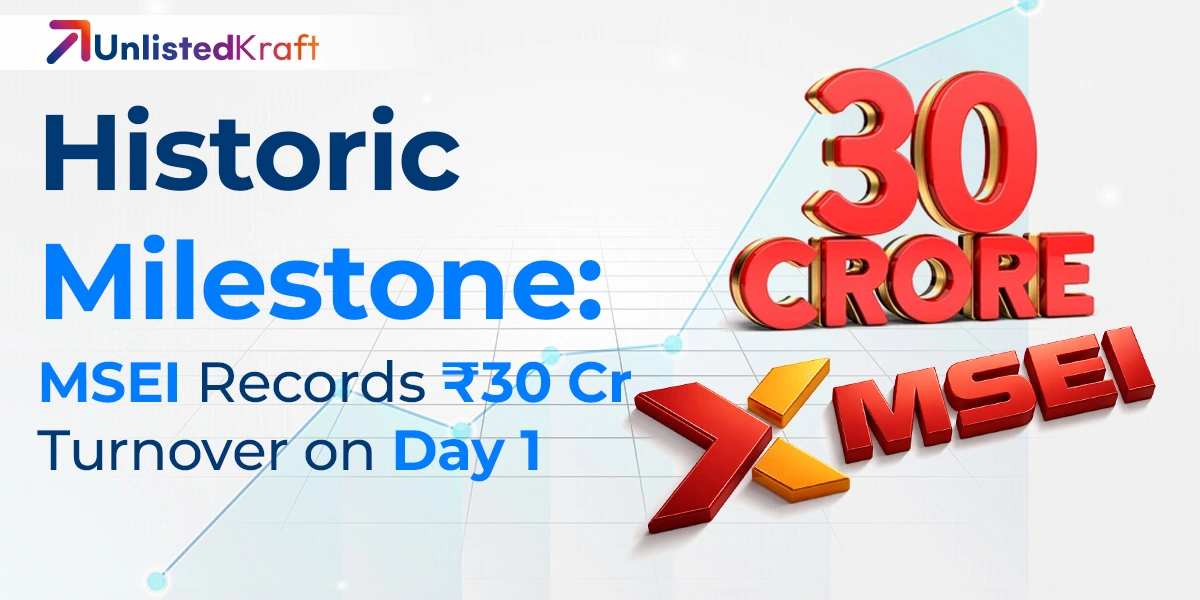
Its newly launched Market Maker Programme in the equity segment generated ₹30.36 crore in turnover on Day 1 alone, with 7,80,674 shares traded by 3:30 PM IST.
This wasn’t a one-hour flash. Volume surged 62.6% in the second half of the trading day, proving sustained participation rather than opening hype.
For unlisted investors, this is more than news. It’s a structural inflexion point that could unlock significant value in MSEI unlisted shares.
In this deep-dive blog, we break down the numbers, analyse the drivers behind the 30-crore Day 1 blockbuster, assess MSEI’s financials and revival roadmap.
How MSEI went from Struggling Third Exchange to Liquidity-Infused Challenger
MSEI (formerly MCX-SX) received SEBI recognition in 2008 and operates across Equity Cash, Equity Derivatives, Currency Derivatives, and Debt segments. Yet, for years, it suffered from the classic “liquidity trap” - low volumes meant low revenue, which meant limited incentive for brokers and traders to participate.
Persistent losses: Net loss of ₹34.22 Cr in FY25 (improved from ₹48.62 Cr in FY24).
Total income in FY25 stood at ₹17.38 Cr, largely propped up by “other income” (interest on fixed deposits) rather than core trading activity.
Despite this, MSEI holds a full national-level license and a clean regulatory track record - a rare and valuable asset in India’s tightly regulated exchange space.
The Catalyst: Market Maker Programme Goes Live (April 1, 2026)
On March 24, 2026, MSEI announced the completion of Market Maker appointments under its Liquidity Enhancement Scheme (LES) for ~130-143 high-quality stocks (including Reliance, HDFC Bank, Infosys, and select emerging names).
Market Makers are obligated to provide continuous two-way quotes, maintain tight spreads (as low as 5 bps), and ensure 85-90% order-book presence.
Day 1 Breakdown (April 1, 2026):
By 1:00 PM IST: 4,80,032 shares | ₹19.65 Cr turnover.
By close (3:30 PM IST): 7,80,674 shares | ₹30.36 Cr turnover.
Volume acceleration: +62.6% in the latter trading hours.
The SX40 index (MSEI’s benchmark) saw broad-based participation, with defence/PSU, banking, IT, and aviation stocks all contributing.
Why This Matters: Exchanges earn primarily from transaction fees, data sales, and listing income. Even capturing 0.1-0.5% of NSE’s daily cash market volume (which routinely exceeds ₹1 lakh crore) would transform MSEI’s economics.
Deep Analysis: 5 Key Reasons Behind the ₹30 Crore Day 1 Turnover
Reason 1: Structural Liquidity Fix via LES & Market Makers
India’s smaller exchanges have historically failed due to the chicken-and-egg problem (no liquidity → no traders → no liquidity). The LES directly solves this with SEBI-aligned incentives: monthly payments to Market Makers (up to ₹40 lakh each), waived transaction charges, and performance-linked rewards. Early data shows the mechanism is working - sustained volume growth intra-day proves genuine two-way interest, not just artificial quotes.
Reason 2: Credibility Boost from Fintech Powerhouses
December 2024 private placement at ₹2 per share saw participation from Billionbrains Garage Ventures (Groww), Rainmatter Investments (Zerodha), Share India Securities, and others. Reports indicate cumulative capital infusion exceeding ₹1,000-1,240 Cr in recent rounds.
This wasn’t a passive investment - these brokers are now incentivised to route orders to MSEI via Smart Order Routing (SOR). Early broker onboarding is already visible.
Reason 3: Preceding Momentum from Mock Trading & LES Rollout
January 2026 mock trading sessions and LES announcement created pent-up demand. Traders, institutions, and arbitrageurs were already testing the platform. Day 1 was the live validation.
Desire for reduced concentration risk (NSE outages remain a concern).
Positive sentiment spillover: Market infrastructure stocks (BSE, CDSL, MCX) rallied on the news.
Reason 5: Network Effect Ignition
Day 1 volumes, though modest compared to NSE/BSE, represent a massive multiple over MSEI’s historical equity turnover (often near zero). If sustained, this creates a virtuous cycle: tighter spreads → better execution → more order flow → higher revenue.
Financial Health Snapshot of MSEI
The following table shows the financial health snapshot of MSEI:
Metric
FY23
FY24
FY25
H1 FY26 Trend
Operating Revenue (₹ Cr)
9.21
7.36
4.31
Low (~₹1.81 Cr annualised est.)
Total Income (₹ Cr)
~54.65
21.05
17.38
Improved via other income
Net Loss (₹ Cr)
-18.67
-48.62
-34.22
Narrowed to ~₹11.53 Cr (H1)
Book Value/Share (₹)
0.5
0.4
~0.36-0.66
Low but equity base strong
Key Insight: Core revenue is still tiny, but the capital base (post-fund raises) and low operational leverage mean even modest volume growth can swing profitability dramatically. Other income (treasury) currently cushions losses.
Direct Impact on MSEI Unlisted Shares – The Opportunity for Investors
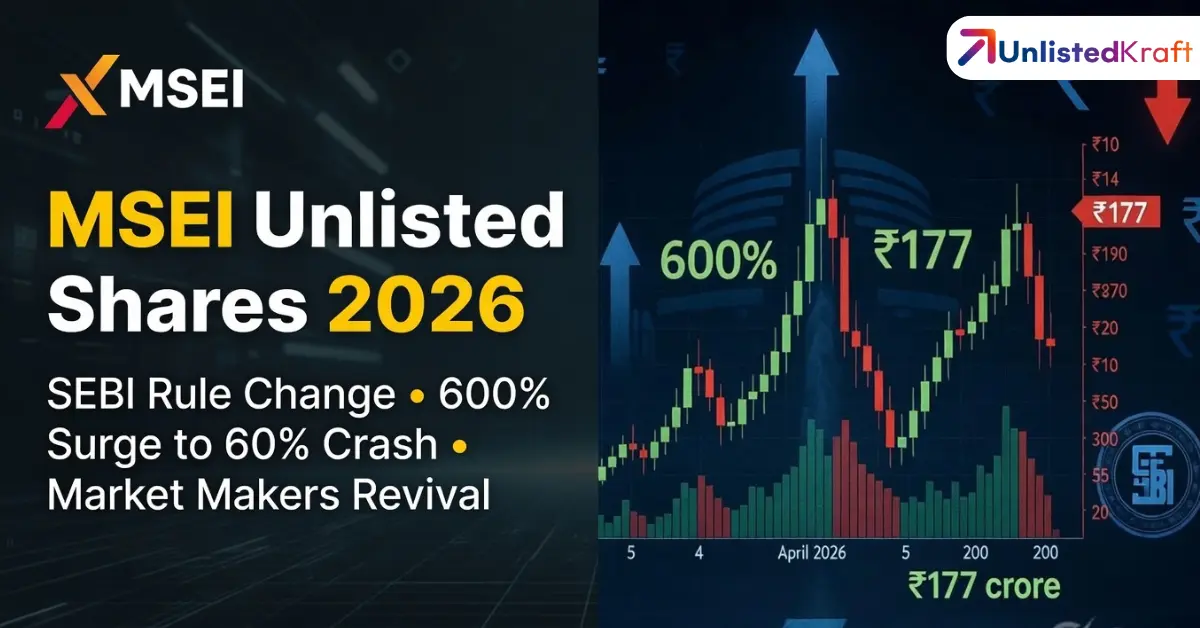
Current Unlisted Price (as of April 2-3, 2026): ~₹4.85–₹5.63 per share (platform variation; face value ₹1). 52-week range: ₹2.5–₹9+.
Why This News is Bullish for Unlisted Holders/Buyers:
Sentiment Re-rating: The 30 Cr Day 1 result validates years of revival efforts. Unlisted shares, which had corrected sharply from ₹12 peaks in early 2025, now have fresh fundamental backing.
Valuation Upside: At ~₹5/share and ~600 Cr shares outstanding, market cap sits around ₹3,000–3,500 Cr. If MSEI sustains even ₹500–1,000 Cr monthly turnover and monetises via fees, revenue could scale 5-10x within 2-3 years - justifying a significant premium.
IPO/Exit Catalyst: Sustained volumes + LES success could pave the way for SME platform expansion or full IPO. Historical precedents (NSE unlisted run-up) show exchanges command rich multiples when liquidity improves.
Liquidity in Unlisted Market: Increased visibility typically boosts demand and tightens bid-ask spreads in the unlisted counter itself.
Risks to Consider
The following are some of the major risks associated with MSEI:
Volumes must sustain beyond the incentive period (LES ends June 2026 initially).
Intense competition from NSE/BSE.
Execution risk in scaling broker participation.
Regulatory or operational delays.
Unlisted shares carry inherent illiquidity and longer exit horizons.
At current valuations and with the Day 1 proof-of-concept, risk-reward remains heavily skewed positive for long-term unlisted investors.
Disclaimer
This is not investment advice. Unlisted shares involve risk and are suitable only for sophisticated investors with high risk tolerance and a long-term horizon. Past performance or recent volumes do not guarantee future results. Conduct your own due diligence or consult a SEBI-registered advisor. All data sourced from public filings and market reports
Author: Diwakar Singh
Diwakar Kumar Singh is a BFSI specialist and finance writer with over 7 years of hands-on experience in financial research, content creation, and analysis.
A Gold Medalist in MBA (Marketing) from IMT, he combines deep analytical skills with practical insights gained from evaluating companies, IPOs, unlisted shares, financial ratios, and investment opportunities. Diwakar has personally analysed hundreds of financial instruments and market scenarios, which he uses to break down complex topics into clear, actionable advice.
He has authored numerous in-depth finance articles, published multiple books internationally, and contributed to research publications. His work focuses on helping everyday investors and readers make better-informed financial decisions through well-researched, evidence-based explanations that are always grounded in real-world application rather than theory alone.
 amit@unlistedkraft.in
 +91-8796470040
 +91-8796470040