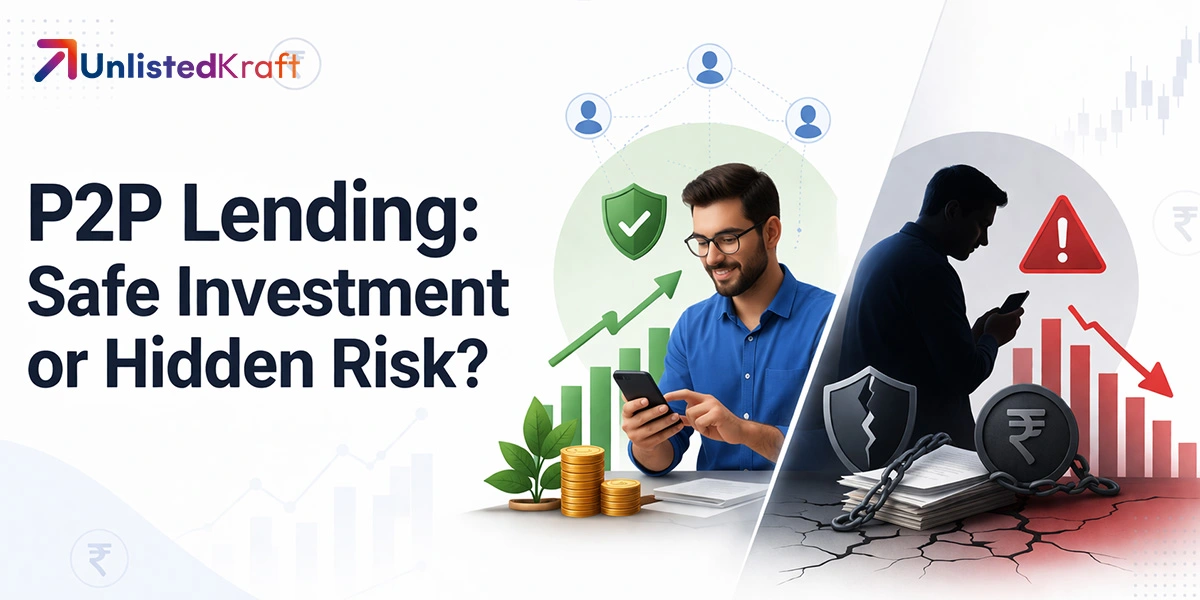
A few years back, many people believed P2P lending would replace banks. Fast forward to today - Banks are still here, NBFCs are growing, and P2P platforms?
Well, they are still around - but not exactly dominating.
So what really happened?
Is P2P lending in India failing or quietly building something big?
Let’s break it down in simple words.
What is P2P Lending?
P2P (Peer-to-Peer) lending means:
You lend money directly to someone through an online platform - no bank in between. Platforms like:
Faircent
LenDenClub
i2iFunding
act as matchmakers between lenders and borrowers.
Think of it like this:
Instead of putting money in an FD, you lend it to a person and earn higher interest. Sounds attractive, right?
But reality is more complicated.
The Journey of P2P Lending in India
Before we get into the complexities of P2P lending, let us first understand how it evolved:
Phase
Timeline
What Happened
Early Stage
2013-2017
New platforms launched, high excitement
Regulation Phase
2,017
The Reserve Bank of India introduced rules
Cleanup Phase
2018-2020
Many weak players shut down
Stabilization
2021-Present
Slow, controlled growth
Key Regulation by RBI for P2P Platforms
RBI made P2P platforms NBFC-P2P entities. The following are some of the key rules and regulations:
Max ₹50 lakh total lending per lender
Max ₹50,000 per borrower
Platforms cannot guarantee returns
Strict KYC and reporting
This made the industry safe but slower.
Current Market Size & Growth
Now let’s talk numbers and the current status of the P2P industry as of 2026:
Short Answer: It is NOT failing, but it is definitely NOT booming either. And it is in a slow, niche growth phase.
Why P2P Lending is NOT Booming
Let’s be honest, if it were truly explosive, you would hear about it everywhere.
Here’s why it hasn’t scaled.
1. Trust Issues
People still think:
“What if the borrower runs away?”
“Who will recover my money?”
Unlike banks, there is no guarantee.
2. High Default Risk
Typical default rates are 3% to 8% (can be higher in risky segments)
That scares conservative investors.
3. No Liquidity
Your money is locked for months/years
No easy exit like mutual funds or stocks
4. Strict RBI Rules
While good for safety, they:
Limit ticket size
Restrict scaling
Reduce aggressive growth
5. Competition is Too Strong
Why take a risk when you have:
FDs (safe)
Mutual funds (liquid)
Personal loan apps (easy lending exposure)
Why P2P Lending is STILL Growing
Now here’s the interesting part.
Despite all problems, it is still growing.
Why?
1. Higher Returns Attract Investors
Typical returns are 10% to 18%
That’s much higher than FDs.
2. Credit Gap in India
Many borrowers:
Don’t get loans from banks
Have a thin credit history
P2P fills this gap.
3. Digital Lending Boom
India is becoming a fintech powerhouse. With:
Aadhaar
UPI
Digital KYC
P2P has the infrastructure to grow.
4. Better Risk Models
Platforms now use:
AI-based credit scoring
Data analytics
This reduces defaults over time.
Penetration of P2P in India
Let us see the penetration of P2P in India:
Segment
Penetration
Urban investors
Low
Tier 2/3 borrowers
Moderate
Overall India
Very Low (<1%)
P2P is still a niche product.
Interesting Facts About P2P You Should Know
The following are some of the interesting facts
India has one of the largest untapped credit markets globally
Over 190 million adults lack access to formal credit
The average P2P ticket size is much smaller than traditional loans
Most lenders diversify across 100+ borrowers to reduce risk
How P2P Lending Works?
Let’s say:
You invest ₹1,00,000 on a P2P platform
Instead of lending to 1 person:
₹1,000 goes to 100 borrowers
If:
95 repay → you earn well
5 default → returns reduce
This is how platforms manage risk and repayments.
Future of P2P Lending in India
Now the big question. Where is this going?
Based on Data & Trends
P2P lending will:
NOT replace banks
NOT become a mass product soon
BUT will grow steadily as an alternative asset class
Expected Growth
Factor
Projection
Market size
₹25,000-30,000 crore by 2030
Growth rate
20-25% CAGR
Adoption
Gradual increase
Key Growth Drivers in P2P Lending
The following are the major factors that contribute to growth in P2P lending:
Rising credit demand
Underbanked population
Tech-driven underwriting
Investors search for higher returns
Key Risks in P2P Lending
Now, the following are the main risks involved in P2P lending:
Economic slowdown → higher defaults
Over-aggressive lending models
Regulatory tightening
Investor awareness gaps
Final Verdict: Boom or Not?
Let us put it very clearly. P2P lending in India is like a slow cooker, not a pressure cooker.
It’s not exploding, but it’s not dying either. It is:
Stable
Regulated
Growing slowly
Still risky
Should You Consider P2P Lending?
Only if:
You understand the risk
You diversify properly
You don’t invest all your money here
Avoid if:
You want guaranteed returns
You panic easily with losses
Conclusion
P2P lending in India is still in its early adulthood. It had hype, and then reality hit. Now it is evolving into a more mature and regulated space.
For investors, it’s an alternative opportunity and not a primary investment. And if used wisely, it can add an extra layer of returns to your portfolio.
Frequently Asked Questions
Is P2P lending safe in India?
It is regulated by RBI, but returns are not guaranteed. There is default risk.
What returns can I expect from P2P lending in India?
Typically between 10% to 18%, depending on risk level.
Which are the top P2P lending platforms in India?
Some known ones include Faircent, LenDenClub, and i2iFunding.
Why is P2P lending not very popular in India?
Due to trust issues, risk of defaults, and lack of awareness.
What is the future of P2P lending in India?
It is expected to grow steadily, but will remain a niche investment option rather than mainstream.
Disclaimer
This content is for informational and educational purposes only and should not be considered financial or investment advice. UnlistedKraft is not responsible for any losses or decisions taken based on this content. Please conduct your own research and consult a qualified financial advisor before making any investment decisions.
Author: Diwakar Singh
Diwakar Kumar Singh is a BFSI specialist and finance writer with over 7 years of hands-on experience in financial research, content creation, and analysis.
A Gold Medalist in MBA (Marketing) from IMT, he combines deep analytical skills with practical insights gained from evaluating companies, IPOs, unlisted shares, financial ratios, and investment opportunities. Diwakar has personally analysed hundreds of financial instruments and market scenarios, which he uses to break down complex topics into clear, actionable advice.
He has authored numerous in-depth finance articles, published multiple books internationally, and contributed to research publications. His work focuses on helping everyday investors and readers make better-informed financial decisions through well-researched, evidence-based explanations that are always grounded in real-world application rather than theory alone.
 amit@unlistedkraft.in
 +91-8796470040
 +91-8796470040