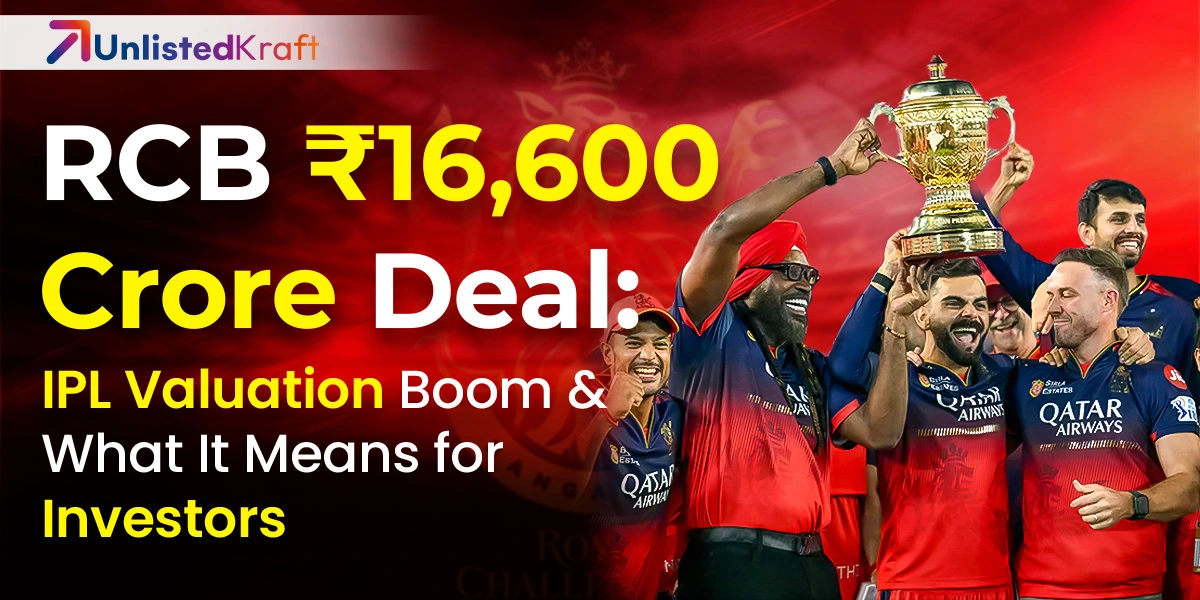
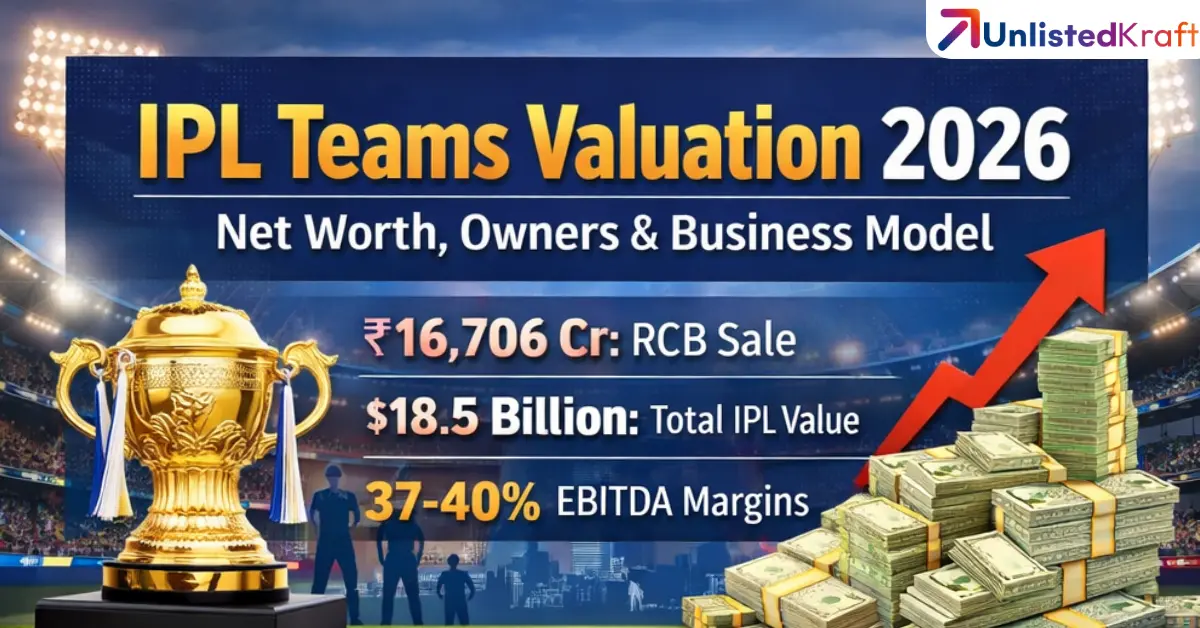
The sale of Royal Challengers Bengaluru at a valuation of $1.78 billion (approximately ₹16,600 crore) is not just another sports headline.
It is a defining moment for how cricket teams are valued in India.
For the first time, IPL franchises are being seen not just as teams, but as serious financial assets. This deal has implications across unlisted shares, stock markets, sponsorship ecosystems, and even fan-driven markets like fantasy sports.
If you are an investor or someone tracking emerging asset classes, this development deserves close attention. Read it till the end to get the complete picture about this deal.
What You’ll Learn After Reading This Blog
The following are the key insights you will gain:
Why RCB achieved a valuation of ₹16,600 crore
What this deal signals about IPL as an investment opportunity
Aditya Birla Group, The Times Group, Blackstone + others
Deal Type
Full ownership transfer
Significance
One of the highest IPL franchise valuations ever
This valuation now acts as a benchmark for the entire IPL ecosystem.
Why Was RCB Valued So High?
The following factors explain the premium valuation:
1. Media Rights Growth
IPL media rights have expanded significantly in recent years. The combination of television and digital streaming has created a multi-billion-dollar ecosystem. Investors are pricing in future revenue potential, not just past performance.
2. Brand Strength Over Performance
While RCB may not have the highest number of trophies, it has:
A large and loyal fan base
Strong digital engagement
High visibility across platforms
This highlights a key shift that in modern sports, brand value can outweigh on-field success.
3. Multiple Revenue Streams
An IPL franchise today generates income from:
Sponsorships
Merchandising
Media rights share
Licensing and digital content
This makes a team comparable to a media and entertainment business.
4. Entry of Institutional Investors
The involvement of firms like Blackstone signals long-term confidence.
Such investors typically look for:
Scalable business models
Predictable cash flows
Strong brand-led growth
What This Means for CSK Unlisted Shares
The following is the direct impact on the Chennai Super Kings.
Effect No.1 | Immediate Re-Rating Effect
The RCB deal creates a psychological benchmark.
If RCB is valued at ₹16,600 crore, investors begin to reassess CSK’s valuation.
This leads to:
Increased demand for CSK unlisted shares
Expectation of upward price movement
Effect No.2 | Early Signals Already Visible
Even before the deal was finalised, market rumours led to:
IPL is increasingly viewed as an investment opportunity, not just entertainment.
Mid-Term Impact (6–24 Months)
Structural Growth
Increase in sponsorship deals
Expansion of merchandising
Greater focus on digital monetisation
Institutional Participation
More investment firms may explore:
Partial stake acquisitions
Strategic partnerships
Long-Term Impact (2–5 Years)
Emergence of IPL as an Asset Class. IPL franchises could become comparable to:
European football clubs
NBA teams
Valuation Expansion
Chennai Super Kings could emerge as a premium asset due to brand and legacy
Mumbai Indians remains a strong contender
Future Possibilities
IPOs of IPL franchises
Global expansion of team brands
Increased institutional ownership
Hidden Layer: Impact Beyond Investing
The following is the broader ecosystem impact.
Perception-Driven Markets
A high valuation influences how teams are perceived.
This can affect:
Fantasy sports selections
Audience expectations
Sponsorship negotiations
In informal markets, perception often drives behaviour. However, it is important to note:
Valuation does not guarantee on-field performance.
Key Takeaway for Investors
This deal is not just about one franchise. It is about:
A shift in how sports assets are valued
The emergence of new investment opportunities
The increasing overlap between sports, media, and finance
The ₹16,600 crore valuation of RCB has effectively reset the benchmark for IPL teams.
Conclusion
The sale of the Royal Challengers Bengaluru marks a turning point. It signals that:
IPL is evolving into a structured financial ecosystem
Teams are being valued as scalable businesses
Early investors in franchises like CSK and the Mumbai Indians could benefit from future valuation expansion
The key question now is not whether IPL teams are valuable.
It is how much more valuable they can become.
Disclaimer
This content is for informational and educational purposes only and should not be considered as investment or financial advice. UnlistedKraft is not responsible for any losses or decisions taken based on this content. Readers should conduct their own independent research and consult qualified professionals before making investment decisions. Information is compiled from publicly available sources believed to be reliable, but is not guaranteed. Data, figures, and views may change without notice. Use this information at your own risk.
Author: Diwakar Singh
Diwakar Kumar Singh is a BFSI specialist and finance writer with over 7 years of hands-on experience in financial research, content creation, and analysis.
A Gold Medalist in MBA (Marketing) from IMT, he combines deep analytical skills with practical insights gained from evaluating companies, IPOs, unlisted shares, financial ratios, and investment opportunities. Diwakar has personally analysed hundreds of financial instruments and market scenarios, which he uses to break down complex topics into clear, actionable advice.
He has authored numerous in-depth finance articles, published multiple books internationally, and contributed to research publications. His work focuses on helping everyday investors and readers make better-informed financial decisions through well-researched, evidence-based explanations that are always grounded in real-world application rather than theory alone.
 amit@unlistedkraft.in
 +91-8796470040
 +91-8796470040