5 Risks of Buying Unlisted Shares and How to Avoid Them
Many investors first hear about unlisted shares when they see some companies delivering strong returns after their IPO. While the potential rewards of unlisted share investments are often discussed, the risks are also worth considering.
For every successful IPO, there may be investors:
- Who received lower returns than expected
- Waited months without an exit or
- Invested without adequate knowledge
However, this doesn't mean unlisted shares are not a good investment option. Like any asset class, they come with certain risks that can often be managed through proper research, realistic expectations, and a long-term approach. If you're planning to enter the unlisted share market, understanding the risks can help you make better investment decisions and avoid costly mistakes.
Unlisted Shares - A Quick Overview
Unlisted shares are pre-ipo investment stocks that are not listed on stock exchanges like the NSE or BSE. These are traded privately through brokers, intermediaries, or platforms that operate in the pre-IPO market. There are various advantages of buying unlisted shares, like early entry at lower valuations, high growth potential, portfolio diversification and wider investment choice.
But before you invest, here are some key risks worth knowing.
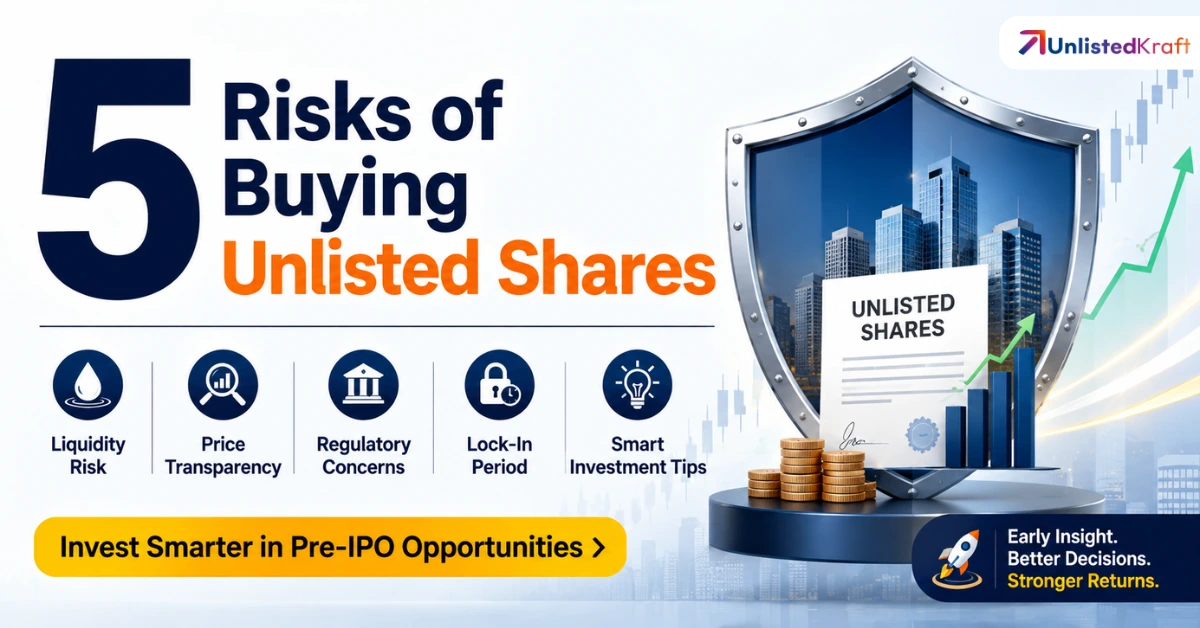
Top 5 Risks of Buying Unlisted Shares
Here are the top 5 risks of Unlisted share investment.
1. Low Liquidity
This is one of the major challenges unlisted share investors often face. Suppose you own a listed share, and now want to sell it. You can sell it within seconds during market hours on the stock exchange. But finding a buyer for unlisted shares is not always that easy. You might have to wait for weeks or even months to sell your holdings.
In case of any financial emergency, you may want to sell early and have money; there is no guarantee that a buyer will be immediately available, and even if you find someone, you may have to accept a lower price to complete the transaction.
2. Limited Information
When a company goes public through an IPO, it has to submit its complete information with SEBI, like Annual Reports, DRHP, RHP, and its Prospectus. Unlike listed companies, the key details and information of unlisted companies are either limited or not easily accessible to the public. Sometimes, investors often make decisions based on limited data, like-
- Just through an enquiry call
- A revenue figure shared by the broker or
- Aggregated news articles
This creates an information gap and may lead to uninformed investment decisions.
3. No Price Transparency
Listed stocks’ prices are determined by the demand and supply forces. In the unlisted share market, prices are set by intermediaries, trading platforms, or through private negotiations.
This creates a situation of a lack of price transparency where the same company's shares might be quoted at very different prices by different sellers, and there is no proven way to verify which one is reasonable.
4. Regulatory Risk
The unlisted market is not directly regulated by SEBI, hence it creates potential risk due to the non-availability of settlement guarantees, depositories, and exchange mechanisms that protect an investor or buyer.
However, the unlisted shares trading is legal in India; there are risks of:
- Sellers claiming to hold shares they don't actually own
- Forged share certificates (this is why demat-based transfers matter)
- Aggressive promotion and selling the shares at inflated prices
5. Lock-in Period Restrictions
Mostly, investors buy pre-IPO shares with an expectation of strong listing gains. But here's something many first-time investors don't realise. SEBI has specified a mandatory 6-month lock-in period for pre-IPO investors (non-promoters) from the date of listing. Suppose you have invested in any unlisted company stocks that have now been listed on the stock exchange, you may want to sell your shares, but due to the lock-in period, you can not sell your shares for 6 months from the listing date.
By the time the lock-in period ends, market conditions or the share price may change. This can impact liquidity and delay an investor's planned exit strategy.
Watch: The Lock-in Period Trap? | Why You Can't Sell Post-IPO!
The risks are real but not unmanageable. Now, let’s understand how you can avoid these risks.
How to avoid the risks of buying unlisted shares?
Here are some recommended ways to avoid the risks associated with the unlisted shares:
1. Invest for the Long-term
Since unlisted shares have low liquidity, it is advised to approach unlisted shares with a long-term investment mindset. In other words, invest only that portion of your money that you can comfortably set aside for a few months or years. Before investing, try to find out how actively a company's shares are being bought and sold on the platform you're using.
2. Do your Research Before Investing
As per the Companies Act 2013, unlisted companies' annual returns must be filed with the Ministry of Corporate Affairs (MCA). Do your own research or ask your broker to give you a brief about the company's financial performance, business model, leadership structure, and growth plans before you make the investment.
3. Compare Prices Before Buying
Since there are several platforms available that facilitate unlisted shares’ trading. You must compare the prices across multiple brokers, intermediaries, or platforms. It will help you avoid overpaying and get a better understanding of the prevailing market price of any particular share.
4. Deal only through Trusted Platforms
Since the unlisted market has limited regulatory oversight, it is important to transact only through reputed brokers, intermediaries, or platforms like UnlistedKraft. Before investing, be cautious about -
- How your shares are transferred
- Availability of proper Demat channels
- Reliable ownership details
5. Understand Lock-in Rules before investing
Understanding the exit timelines of unlisted shares is very important. Before you invest in pre-IPO shares, check the lock-in period timelines to estimate how long your money may remain invested. Setting up realistic expectations about exit timelines helps arrange your funding in a better way.
If you're planning to start investing in unlisted shares, considering these risk factors and how to avoid them is important to evaluate the best unlisted shares to buy in India.
Summary
Investment in unlisted shares depends entirely on your financial situation, risk-taking capability, and investment goals. The risk factors, such as low liquidity, limited information, no price transparency, regulatory risks, and lock-in period restrictions, can all affect your investment outcome. However, with proper research and the right investment approach, this pre-IPO investment opportunity can also be genuinely rewarding.
Frequently Asked Questions
What are the risks of buying unlisted shares in India?
The key risks of buying unlisted shares include low liquidity, limited publicly available information, lack of price transparency, limited regulatory oversight, and lock-in period restrictions after an IPO.
Should I invest in unlisted shares?
Yes, but it depends on your financial situation, risk factor, and investment goals. If you can afford to lock in your money for a longer period, considering the other risk factor, investment in unlisted shares can be rewarding.
Are unlisted shares regulated by SEBI?
Unlisted companies are not directly regulated by SEBI the way listed companies are. However, buying and selling unlisted shares is entirely legal in India under the Companies Act, 2013.
How are unlisted shares traded in India?
Unlisted shares are traded privately through brokers, intermediaries, or online platforms that specialise in unlisted share transactions.
Can unlisted shares be held in a demat account?
Yes, in fact, having a Demat account is mandatory to invest in unlisted shares in India.
How to invest in unlisted shares in India?
You can invest in unlisted shares through brokers, intermediaries, or trusted online platforms that facilitate unlisted share transactions. Before investing, research the company's financials, understand the risks involved, and ensure all transfers happen through proper demat channels.
Disclaimer: This blog is for informational purposes only and does not constitute investment advice. Investing in unlisted shares involves risks. Always consult a professional before making any investment decisions.
Author: Komal Bhatt
Komal Bhatt is a finance content writer at InvestKraft, specialising in well-researched articles on financial products, stock markets, and investment opportunities, with a particular focus on unlisted shares.
She holds a Master’s degree in Commerce from the University of Delhi, which gives her a solid academic foundation in finance and business. With over three years of hands-on experience in creating digital finance content, Komal has developed a clear understanding of investor needs through her work on wealth management, NISM certification programs, and market education materials.
Komal is passionate when it comes to breaking down complex financial concepts into simple, accurate and actionable insights. Her goal is to help everyday investors understand markets better and make more informed decisions based on reliable, research-backed information.

 amit@unlistedkraft.in
 +91-9599071664
 +91-9599071664









.webp)
 (1).webp)


 +91-9599071664
 amit@unlistedkraft.in