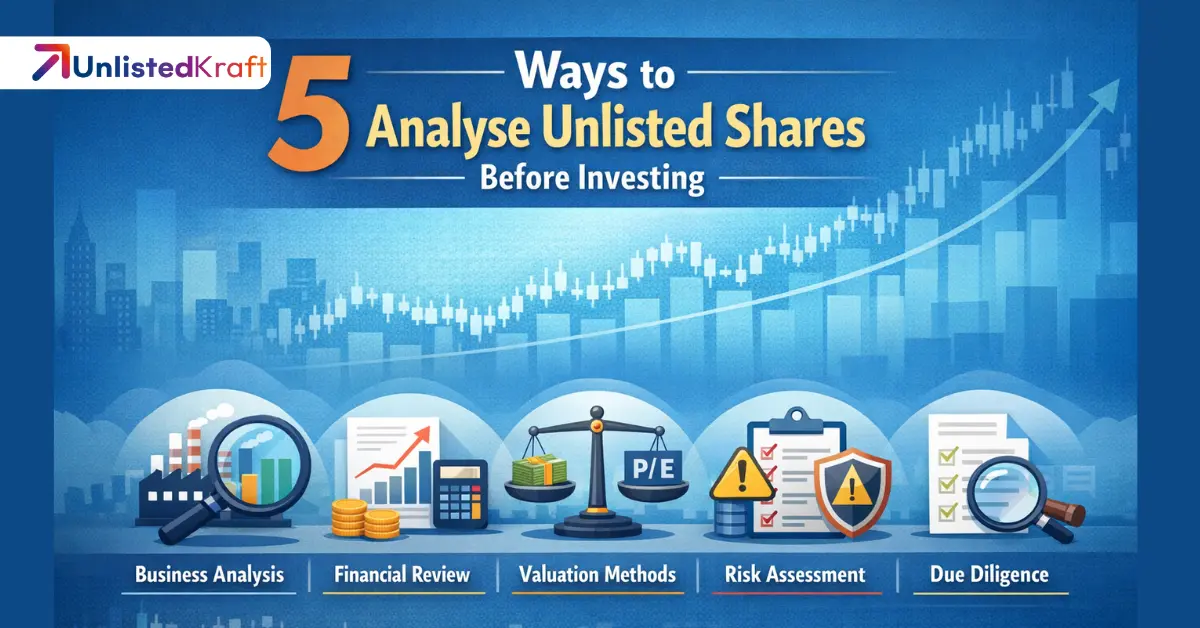
5 Ways to Analyse Unlisted Shares Before Investing
Unlisted shares or you can say pre ipo shares, look exciting. Early entry. High return stories. IPO buzz.
But let’s be honest.
They are not easy money. Unlisted shares need deep analysis.
Less data. Less regulation. Less liquidity. That’s why many investors make mistakes.
If you want to invest smartly, not emotionally, this guide is for you.
Let’s understand 5 simple but powerful ways to analyse unlisted shares before putting your hard-earned money.
 1. Business & Industry Deep Dive
Before pre ipo investing, it is very important to understand what the company actually does and whether its business makes sense. Apart from numbers, understand the business story. There are four aspects of this:
Understand the Business Model
Ask simple questions:
- What problem does the company solve?
- Who pays for the product or service?
- How does it earn money?
This is called unit economics. If the business earns more per customer than it spends, that’s a good sign.
Industry Potential
Check if the company operates in a growing sector.
Examples:
- FinTech
- HealthTech
- EV ecosystem
- Renewable energy
Ask:
- Is the market expanding?
- Is demand increasing?
- Is the sector future-ready?
USP & Scalability
What makes the company different?
- Strong brand?
- Technology advantage?
- Cost leadership?
Also, see if the model can scale without burning cash.
Management Quality
This is very important in unlisted shares.
Look at:
- Promoter background
- Past track record
- Corporate governance history
A good promoter protects minority shareholders, not just themselves.
2. Financials & Growth Metrics
You need to know how to read limited financial data and what numbers really matter.
Unlisted companies don’t disclose everything. Still, try to get basic financials. At UnlistedKraft, you can see the detailed reports, balance sheets and other financial documents of various companies.
Revenue & Profit Growth
Look for:
- Consistent year-on-year growth
- A CAGR above 20% is considered strong
Avoid companies with random spikes and drops.
Profitability
Key metrics to check:
- Net Profit Margin: Above 10% is ideal
- EBITDA Margin: Stable or improving
- ROE: Above 15% is good
Profit shows business strength. Growth without profit is risky.
Balance Sheet Health
Check debt levels.
- Debt-to-Equity below 0.5 is a strong signal
- Too much debt can kill future growth
3. Valuation - The Toughest Part
You also need to know how to judge whether the price of unlisted shares is fair. Valuation is tricky because prices are not transparent.
Discounted Cash Flow (DCF)
This method estimates:
- Future earnings
- Discounts them to today’s value
It is powerful but depends on assumptions. So be conservative.
P/E Ratio
Compare with similar listed companies.
- P/E between 15 - 40 can be reasonable
- A very high P/E means high expectations
P/B Ratio
Useful for NBFCs and financial companies.
- P/B below 2 may signal undervaluation
Price Negotiation
Unlike stock exchanges:
- Prices are negotiable
- Different sellers quote different prices
Always negotiate based on:
- Growth potential
- Risk
- Liquidity challenges
4. Risk Assessment & Due Diligence
You have to understand the hidden risks that many investors ignore. Unlisted shares come with extra risks.
Liquidity Risk
- Buying is easy
- Selling is hard
You may wait months or years to exit.
Regulatory Risk
- Less SEBI oversight
- Limited public disclosures
- Lower transparency
Exit Risk
- No guarantee of IPO
- No assurance of buyback
- Exit depends on market demand
Counterparty Risk
- Transactions rely on trust
- No exchange protection
- Documentation is critical
Never invest without understanding these risks fully.
5. Actionable Steps Before You Invest
You must know the exact next steps to invest safely in unlisted shares.
Do Your Own Due Diligence
- Verify company details
- Check the share transfer process
- Review legal documents
Take Professional Help
Unlisted investing is not DIY for everyone.
- Valuation experts
- Unlisted share platforms
- Legal advisors
Expert support reduces costly mistakes.
Keep Allocation Small
Unlisted shares should be a small part of your portfolio. Never invest money you may need urgently.
Understand All Costs
- Dealer commissions
- Transfer charges
- Holding risks
Hidden costs reduce real returns.
If you want to brush up on your basics or want to improve your knowledge on unlisted shares, then we have a dedicated article on Everything About Unlisted Shares, which you can read.
Conclusion
Unlisted shares can be rewarding. But only with patience, analysis, and discipline. If done blindly, they can trap your money for years. If done smartly, they can create long-term wealth.
Frequently Asked Questions
How do I analyse unlisted shares before investing?
To analyse unlisted shares, study the business model, management quality, financial growth, valuation metrics, and risks like liquidity and exit challenges.
Are unlisted shares more risky than listed shares?
Yes. Unlisted shares carry higher risks due to low liquidity, limited disclosures, and a lack of active regulatory oversight compared to listed shares.
Which valuation method is best for unlisted shares?
DCF is commonly used for unlisted shares, along with P/E and P/B comparison with similar listed companies to judge fair value.
How much should I invest in unlisted shares?
Unlisted shares should form only a small portion of your total portfolio, as exits are uncertain and capital may remain locked for years.
Can I easily sell unlisted shares anytime?
No. Selling unlisted shares is difficult due to low liquidity. You must find buyers privately, and exits are not guaranteed.
What is pre ipo?
Pre IPO means when a company offers its shares to investors before going public through an IPO.
Author: Diwakar Singh
Diwakar Kumar Singh is a BFSI specialist and finance writer with over 7 years of hands-on experience in financial research, content creation, and analysis.
A Gold Medalist in MBA (Marketing) from IMT, he combines deep analytical skills with practical insights gained from evaluating companies, IPOs, unlisted shares, financial ratios, and investment opportunities. Diwakar has personally analysed hundreds of financial instruments and market scenarios, which he uses to break down complex topics into clear, actionable advice.
He has authored numerous in-depth finance articles, published multiple books internationally, and contributed to research publications. His work focuses on helping everyday investors and readers make better-informed financial decisions through well-researched, evidence-based explanations that are always grounded in real-world application rather than theory alone.

 amit@unlistedkraft.in
 +91-8796470040
 +91-8796470040










.webp)
 (1).webp)
