Imagine you’re about to buy a car. You’d study its brochure, compare models, read reviews – all before making that big purchase decision. Investing in an IPO is similar. Before you put money into a public offering, you want all the facts about the company. In an IPO, the Draft Red Herring Prospectus (DRHP) serves this role. It’s the detailed “brochure” filed with SEBI that lays out a company’s business, financials, and plans
Just as you wouldn’t skip reading the car manual, investors use the DRHP to learn what an IPO is about. This guide will explain terms like DRHP, updated DRHP (UDRHP), RHP, Prospectus and the newer “confidential DRHP” route, with examples for Indian companies.
Before we begin, let us get a broad overview of the steps that are involved in the launch of any IPO.
IPO Process Overview: Key Documents Explained
Below is a simplified table summarising these key documents and stages:
Document
When Filed
Key Contents
Notes
DRHP (Draft Red Herring)
Early IPO stage (filed with SEBI)
Company overview, financials, business model, risks, use of funds. No final share price or count.
Preliminary disclosure for SEBI review.
UDRHP (Updated DRHP)
After SEBI’s comments
Revised disclosures (updated financials, risk factors, etc.) as per SEBI’s observations
Filed if SEBI requires significant changes.
RHP (Red Herring)
After SEBI approval of DRHP
Final issue size, price band, detailed prospectus info (financials, risks, management, etc.)
Public offer document used for marketing.
Prospectus (Final)
After pricing (close to IPO date)
Final issue price and share count, definitive details for investors
Filed with regulators and distributed to investors.
Each of these documents is crucial for transparency.
Investors rely on the DRHP and RHP to understand a company’s background and to make informed bids. Now let’s look at each term in more detail.
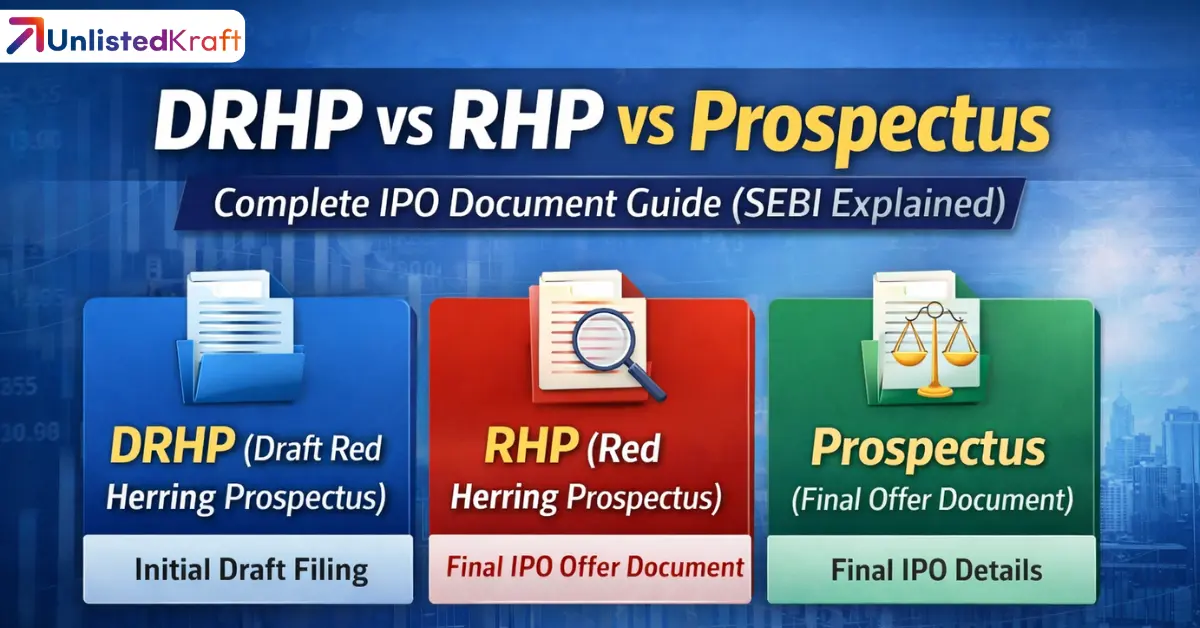
What Is a DRHP (Draft Red Herring Prospectus)?
The DRHP (Draft Red Herring Prospectus) is the first official document a company files before launching its IPO. It works like a detailed brochure that helps investors understand the company before investing.
The following are covered in a DRHP:
Explains what the company does, why it wants to raise money, and how IPO funds will be used
Covers financials, business model, management, promoters, industry outlook, and key risks
Acts as the primary information source for investors evaluating an upcoming IPO
Does not include the final issue price or share quantity as pricing is decided later through book building
Filed with SEBI for review, after which the company updates it based on regulatory observations before moving ahead with the IPO
What is a Confidential DRHP (Pre-filing Route)?
Companies can now choose to file their DRHP confidentially under SEBI’s pre-filing route.
This allows IPO documents to be reviewed by SEBI without being disclosed publicly at the initial stage.
The following are the key points about Confidential DRHP:
Introduced by SEBI in late 2022 as an optional IPO filing mechanism
The draft offer document is filed privately with SEBI and stock exchanges
Known as PDRHP (Pre-filed Draft Red Herring Prospectus)
Becomes public only after SEBI issues its observations
The public version is filed later as UDRHP / UDRHP-I
What exactly happens in a Confidential DRHP filing?
Under the traditional IPO route, once a company files its DRHP with SEBI, the document is immediately made public on SEBI’s website. This means competitors, media, and investors can access all details even if the IPO eventually gets delayed or cancelled.
With the confidential DRHP route, the company first submits its IPO documents privately. SEBI reviews the draft, raises queries, and suggests changes - all without public disclosure. Only after SEBI completes its review does the company file an updated DRHP, which is then made public and followed by the RHP and IPO launch.
Why do companies prefer the confidential DRHP route?
The following are some of the most common reasons why companies prefer the confidential DRHP route:
Privacy of sensitive information: Filing confidentially keeps critical business data like financials, valuations, and growth strategies away from competitors and market speculation.
Better market timing flexibility: SEBI allows companies using the pre-filing route up to 18 months to launch their IPO (compared to 12 months under the normal route), provided the updated DRHP is filed within 16 months. This helps companies wait for favourable market conditions.
Controlled communication: Since the draft is seen only by SEBI and select institutional investors initially, management can fine-tune disclosures without media pressure.
Avoiding unnecessary speculation: If an IPO is postponed after a public DRHP filing, it can create negative headlines and investor confusion. Confidential filings help companies avoid reputation damage if plans change.
SEBI officially describes this route as an “optional mechanism” that gives issuers flexibility while maintaining regulatory oversight.
Once SEBI’s review is complete, the company files a public UDRHP, making the IPO process transparent for all investors, just at a more suitable time.
Example: OYO’s recent confidential DRHP Filing
A recent example of the confidential DRHP route in action is PRISM, the parent company of hospitality giant OYO. On December 31, 2025, PRISM filed a confidential Draft Red Herring Prospectus (DRHP) with SEBI to raise up to ₹6,650 crore through an IPO.
In the past, other Indian companies, such as Tata Capital and Aequs, have also opted for the confidential DRHP route to gain flexibility on timing and avoid early public disclosure of sensitive details before launching their IPOs.
What is an Updated DRHP (UDRHP)?
After reviewing the DRHP, SEBI may ask the company to update or clarify certain details.
This revised version is called the Updated Draft Red Herring Prospectus (UDRHP).
The following are covered in a UDRHP:
Filed when SEBI raises observations on the original DRHP
Includes updated financials, revised risk factors, and clearer disclosures
Reflects current market conditions and regulatory requirements
Acts as a refined and more accurate version of the original DRHP
Once SEBI accepts the UDRHP, the IPO can move to the next stage
What is In-Principle Approval (Stock Exchange Listing)?
At this stage, the company seeks approval from the stock exchange where it plans to list.
This approval confirms that the IPO documents meet exchange listing requirements.
The following are covered in In-Principle Approval:
Applied for with NSE/BSE for Mainboard IPOs and NSE Emerge or BSE SME for SME IPOs
Exchanges review the draft prospectus and SEBI observations
Confirms compliance with listing and regulatory norms applicable to Mainboard or SME IPOs
Indicates the exchange has no objection to listing the shares post IPO
Usually received before the RHP is filed publicly, subject to final compliance
What is a Red Herring Prospectus (RHP)?
After SEBI clears the updated draft, the company files the Red Herring Prospectus (RHP).
This is the final offer document released just before the IPO opens.
The following are covered in RHP:
Includes all DRHP/UDRHP details and IPO-specific information
Clearly mentions the issue size, price band, and IPO timeline
Used by investors to place bids during the book-building process
Reviewed by SEBI for accuracy and completeness
Basis for roadshows and investor meetings led by book-running managers
What is a Prospectus (Final Offer Document)?
After book-building is completed and the final price is decided, the company files the Prospectus. This is the last and final IPO document issued before shares are offered to the public.
The following are mentioned in a prospectus:
Final issue price and exact number of shares
All other details remain the same as mentioned in the RHP
Serves as the legally binding offer document for investors
Filed with SEBI and the Registrar of Companies (RoC)
Once approved, the IPO officially opens for public subscription
Conclusion
The DRHP, RHP and Prospectus are the legal disclosures that let you see the details of a company. A well-prepared DRHP (and RHP) lays out everything from business strategy to financial health and risks.
As per the SEBI mandates, these documents must be accurate and complete, so regulators and investors can rely on them. Whether a company files normally or uses SEBI’s confidential route, the end goal is transparency for investors.
Frequently Asked Questions
What is DRHP in SEBI?
DRHP stands for Draft Red Herring Prospectus, which is filed by a company with SEBI before launching an IPO. It contains detailed information about the company’s business, financials, risks, and IPO plans, but does not include the final issue price.
What is DRHP in an IPO?
In an IPO, the DRHP is the first official document that helps investors understand the company before investing. It explains why the company is going public, how the funds will be used, and the key risks involved in the IPO.
What is the difference between DRHP and RHP in an IPO?
The DRHP is a draft document filed for SEBI’s review and does not include pricing details, while the RHP (Red Herring Prospectus) is filed just before the IPO opens and includes the price band, issue size, and bidding details for investors.
Where can I find the list of DRHPs filed with SEBI?
You can find the list of DRHPs filed with SEBI on:
These platforms regularly update details of the mainboard and SME IPO filings.
Where can investors download or read a DRHP?
Investors can read or download a DRHP from:
SEBI’s official website
NSE or BSE websites
Websites of lead managers (merchant bankers)
Trusted financial platforms covering IPOs
Reading the DRHP is an important first step before applying for any IPO.
Author: Diwakar Singh
Diwakar Kumar Singh is a BFSI specialist and finance writer with over 7 years of hands-on experience in financial research, content creation, and analysis.
A Gold Medalist in MBA (Marketing) from IMT, he combines deep analytical skills with practical insights gained from evaluating companies, IPOs, unlisted shares, financial ratios, and investment opportunities. Diwakar has personally analysed hundreds of financial instruments and market scenarios, which he uses to break down complex topics into clear, actionable advice.
He has authored numerous in-depth finance articles, published multiple books internationally, and contributed to research publications. His work focuses on helping everyday investors and readers make better-informed financial decisions through well-researched, evidence-based explanations that are always grounded in real-world application rather than theory alone.
Track The
Next Big IPO
Discover upcoming IPOs before they hit the market.
 amit@unlistedkraft.in
 +91-8796470040
 +91-8796470040
 IPO Process Overview: Key Documents Explained