Questions to Ask Your Broker Before Buying Unlisted Shares
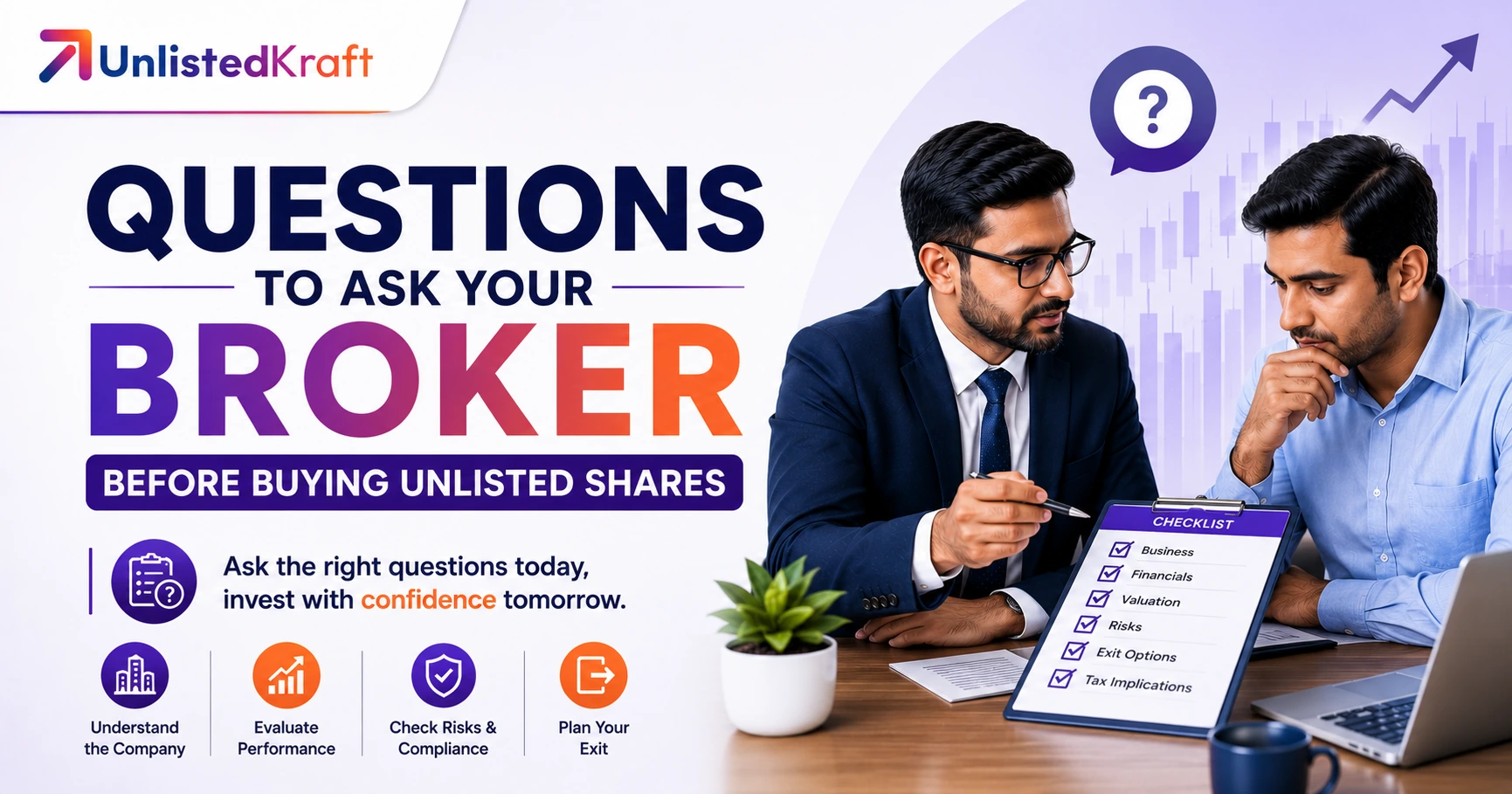
Investing in unlisted shares can be rewarding, but it also comes with its own set of challenges. Unlike listed stocks, the unlisted market has no regulated pricing, no mandatory company disclosures, and limited liquidity. Keeping yourself informed about every important aspect can help you invest wisely.
Before you invest your money into any unlisted company, you must ask your broker about the company, the price you are being quoted, how you will eventually exit, and the tax implications. Getting clear answers to these questions will not just help you make a better decision, it will help you avoid the kind of losses that are very hard to recover from.
Top Questions to Ask Your Broker Before Investing in Unlisted Shares
Whether you are a beginner in unlisted share investments or someone who has already invested, here are some of the most important questions you must ask your broker before going ahead.
Q1. What does the company actually do, and how does it make money?
Before looking at returns, you should understand the company's business. If you don’t know how the company works and makes money, it may be difficult to evaluate its long-term potential. So, always ask your broker about:
- The company's products or services
- Its target customers
- Revenue sources
- Industry growth potential
- Competitive advantages
- DRHP Filed or IPO Plans
Q2. Can I review the company’s financial performance?
However, unlisted companies are not required to publish their financials publicly, but they do file their reports with government corporate regulators. So ask your broker to help you understand and evaluate the company’s:
- Revenue growth over the last 3–5 years
- Profitability trends
- Debt levels
- Cash flow position
- Latest audited financial statements
Q3. What is the shareholding structure of the company?
It is important to know how the company is owned. A detailed breakdown of the ownership structure of the company must be asked. The ownership structure can reveal important information about investor confidence and promoter commitment. Ask for information regarding:
- Promoter shareholding
- Institutional investor participation
- Employee stock option plans (ESOPs)
- Recent changes in ownership
Q4. Who are the promoters and the management team, and what is their track record?
Ask your broker about the background of the founders and the management team of the company. Try to gather details about the:
- Promoter’s experience in the industry
- Track record of building and scaling businesses successfully
- Company’s Corporate Governance Structure
- Related-party transactions, or governance concerns
Q5. Are there any legal, regulatory, or compliance issues with the company?
Always check with your broker whether the company is having any ongoing lawsuits, regulatory investigations, tax disputes, compliance-related issues, or any significant liabilities. Not asking this may certainly affect the value of your investment.
Q6. How is the share price determined?
Unlisted shares’ prices are not determined by the Supply and demand market forces, unlike listed shares. The price quoted by the broker is based on one or more of the following: recent transaction prices between private buyers and sellers, P/E ratios compared to listed peers, book value, revenue multiples, or demand in the grey market. It is important to ask how the price is determined.
Q7.How does the current valuation compare to listed peers?
Just finding out how the price is determined is not enough, you must compare the company’s valuations with those of its relevant peers or competitors in the industry. You may ask your broker for such a comparison using metrics like P/E ratio, revenue multiples, or book value.
Q8.What is the minimum investment amount and additional charges involved?
However, there is no predefined standardised minimum investment amount for Unlisted shares. It depends on various factors, like which share you are investing in and which aggregator platform you are using. Understand the minimum amount required and see whether the platform allows you to buy smaller lots if you want to start with limited exposure.
Also, before you finalise your investments, ask your broker about any additional charges involved, such as:
- Brokerage fees
- Advisory charges
- Stamp duty (applicable on share transfers in India)
- Any other platform fees
Q9. When and how can I sell my unlisted shares?
Unlike listed stocks, you cannot simply log into your trading account and sell unlisted shares when you want. Your exit options are limited to an IPO (if one is planned), a company buyback, or finding another private buyer through the broker's network. Ask your broker which of these is realistic for the company you have chosen and how it will be done.
Q10.What is the ideal holding period for unlisted shares?
Unlisted shares are not generally meant for short-term trading. It is generally advisable and recommended to invest in unlisted shares if you can hold this investment at least for a period of 3 to 5 years to see meaningful returns. If you think you might need this money earlier or want high liquidity for your investment, unlisted shares may not bring the right returns to you.
Q11. Are there any lock-in period restrictions?
Yes, and this is one of the most important things to clarify before buying pre-IPO shares. Once the company is listed, you cannot sell your shares immediately. If it is a Mainboard IPO, non-promoter pre-IPO investors face a lock-in of 6 months from the date of allotment. If it is an SME IPO, that lock-in extends to 1 year. So, depending on which kind of company you are buying into, your shares could be restricted for anywhere between six months and a year after listing.
Q12. How Will the Shares Be Transferred to My Demat Account?
Unlisted shares are stored in a Demat Account. If you are new to unlisted share investments, it's very important to understand the complete procedure of your shares getting transferred to your demat account. Ask your broker about:
- Expected transfer timeline
- Required documentation
- Payment receipt, if applicable
Q 13. What documentation will I get to confirm legal ownership of the shares?
It is very important to ask your broker what documents you will receive that confirm the ownership of your shares. Generally, once the shares are transferred, you receive a contract note, transaction agreement, or transfer confirmation that ensures that the shares are actually in your Demat account before you consider the transaction complete.
Q14. What Are the Tax Implications of Selling Unlisted Shares?
It is important to ask your broker about the taxation rules and holding period requirements in unlisted shares. Moreover, the tax implications of selling unlisted shares are as follows:
- Selling the shares within 24 months of buying: The profit is treated as Short-Term Capital Gain (STCG) and is taxed at your applicable income tax slab rate.
- Selling the shares after 24 months of buying: The profit is treated as Long-Term Capital Gain (LTCG) and taxed at 12.5%.
Note: There is no Securities Transaction Tax (STT) on unlisted share transactions since STT only applies to trades on recognised stock exchanges.
Summary
While the potential investment opportunities in top unlisted shares are attractive, investors should also focus on understanding the company, its valuation, financial health, management quality, and exit options before making a decision. Asking these questions doesn’t guarantee investment success, but they can help you identify risks, evaluate opportunities more effectively, and make more informed investment decisions.
Disclaimer: This blog is for informational purposes only and does not constitute investment advice. Like all other investments, investing in unlisted shares involves risks. Please consult a professional before making any investment decision.
Author: Komal Bhatt
Komal Bhatt is a finance content writer at InvestKraft, specialising in well-researched articles on financial products, stock markets, and investment opportunities, with a particular focus on unlisted shares.
She holds a Master’s degree in Commerce from the University of Delhi, which gives her a solid academic foundation in finance and business. With over three years of hands-on experience in creating digital finance content, Komal has developed a clear understanding of investor needs through her work on wealth management, NISM certification programs, and market education materials.
Komal is passionate when it comes to breaking down complex financial concepts into simple, accurate and actionable insights. Her goal is to help everyday investors understand markets better and make more informed decisions based on reliable, research-backed information.

 amit@unlistedkraft.in
 +91-8796470040
 +91-8796470040






.webp)
 (1).webp)
