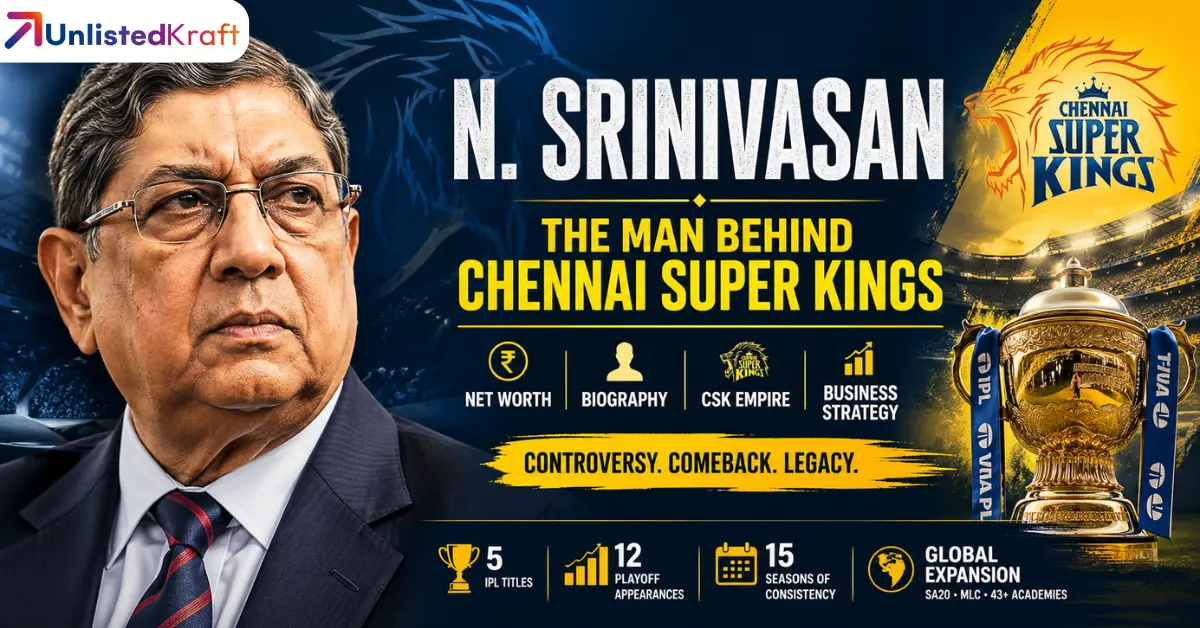
If there is one owner in IPL history who divides opinion more sharply than any other, it is Narayanaswami Srinivasan.
N. Srinivasan - The Iron Hand Behind Chennai Super Kings
To CSK fans, he is the man who built the most consistent franchise in Indian cricket. Five titles, twelve playoff appearances in fifteen seasons, and a brand so strong that it survived a two-year ban and came back stronger.
To his critics, he is the symbol of everything that goes wrong when power, cricket administration, and business interests are allowed to sit in the same chair.
The truth, as it usually is with Srinivasan, sits somewhere uncomfortably in between.
The Man Behind the Name
He holds a Bachelor of Science from Loyola College, Chennai, and a Master of Science in chemical engineering from the Illinois Institute of Technology in Chicago. The man is technically trained, analytically sharp, and - as his career would show - extremely difficult to dislodge once he has planted his flag.
He took over as Vice Chairman and Managing Director of India Cements in 1989, where he made some of the boldest corporate moves of his era - including one of India's first successful hostile takeovers when he absorbed Andhra Pradesh-based Raasi Cements in the 1990s.
This combative, unyielding character would define not just how he ran a company, but how he ran a cricket franchise - and how he handled some of the most explosive controversies in Indian cricket's history.
How He Got Into Cricket & Rewrote the Rules to Stay
Srinivasan was introduced to cricket administration through former BCCI president A.C. Muthiah, climbing through the ranks - first as Secretary of the BCCI, then rising to become its president in 2011. But his relationship with power was never comfortable for those around him.
When the IPL launched in 2008, the Chennai franchise was sold to India Cements for $91 million, making it the fourth most expensive team in the league. N. Srinivasan, who was then the treasurer and vice-chairman of the BCCI, became the de facto owner of the Super Kings as the managing director of India Cements - a direct conflict of interest that critics pointed to from the very beginning. He navigated around it anyway. That willingness to operate at the edge of the rulebook would become a recurring theme.
Building Chennai Super Kings
Whatever you think of how Srinivasan operates off the field, on the field the results speak for themselves. Since 2008, CSK has reached the knockouts in 12 of their 15 seasons - a record of consistency no other IPL franchise comes close to matching.
The philosophy Srinivasan brought to CSK ownership was fundamentally different from most franchise owners. Where others rebuild, he retained. Where others chased youth and auction-room trends, he trusted experience and loyalty.
The decision to make MS Dhoni the anchor of the entire franchise - giving him near-absolute authority over team composition and strategy - proved to be one of the shrewdest ownership calls in IPL history.
Stephen Fleming has been CSK's head coach since 2009 - a tenure that has become a hallmark of the franchise's consistency. In a league where coaches come and go every few seasons, that kind of continuity is remarkable - and it reflects Srinivasan's ownership style: once you earn his trust, you keep your seat.
In 2013, Indian cricket was rocked by a spot-fixing scandal - and CSK was right at the centre of it. Gurunath Meiyappan, who held a senior role in CSK and was also Srinivasan's son-in-law, was found guilty of placing illegal bets on IPL matches, including games involving his own team, and had direct links with bookies. The defining crisis forced Srinivasan to step aside as BCCI chief. Despite a temporary return, the Supreme Court intervened in 2014, ordering him to step down. In 2015, the Supreme Court confirmed his conflict of interest, CSK was banned for two years, and Srinivasan was removed as ICC chairman. For most franchise owners, this would have been a terminal blow. For Srinivasan, it was turbulence to be managed.
Although Srinivasan was not directly accused of betting, he came under fire due to a conflict of interest, as both CSK owner and BCCI president, the court was critical of his dual role. He maintained throughout that he had done nothing wrong. He credited Dhoni and the CSK players for dealing with the crisis with “cold-blooded focus.”
The Greatest Comeback in IPL History
When CSK returned in 2018 after their two-year ban, the cricketing world was skeptical. The team were mocked as "Dad's Army" - an aging side with an average age pushing 34, led by a captain many felt had passed his peak. What followed was one of the most satisfying storylines the IPL has ever produced. With MS Dhoni back as captain, CSK silenced their critics by winning the 2018 championship, defeating Sunrisers Hyderabad in the final. They then reached the final again in 2019, won the title again in 2021, and added a fifth crown in 2023.
From suspension to five-time champions - no other IPL franchise has pulled off anything close to that arc.
The comeback was not just a cricketing achievement. It was a statement from Srinivasan about how he had built the franchise on a culture of loyalty, experience, and calm under pressure that outlasted even his own removal from the BCCI and ICC. The brand survived because the foundation was deeper than any one controversy.
Taking CSK Global - Beyond the IPL
Srinivasan's ambitions for the CSK brand have never been limited to India alone. Beyond their domestic success, CSK has expanded its brand internationally, owning teams in other prominent T20 competitions - the Joburg Super Kings in South Africa's SA20 league and the Texas Super Kings in the United States' Major League Cricket.
The franchise holds a 55.5% stake in Texas Super Kings in Major League Cricket, USA, reducing dependence on the IPL and creating long-term global franchise value.
The expansion does not stop there.
CSK runs 43 academies globally - around 10 in the United States and nearly 30 in India - with talks underway to expand to Singapore, the UK, and Australia. The CEO of CSK, Kasi Viswanathan, has stated that the team plans to be the world's leading T20 franchise by 2030, with plans to invest ₹150-200 crore in building a High Performance Centre at Navalur to boost training and development capabilities.
For a franchise that many assumed would be content resting on its domestic legacy, this is an unmistakably global vision - one that Srinivasan has set the strategic direction for, even as the day-to-day execution increasingly falls to the next generation.
A New Era - The Generational Shift
N. Srinivasan has returned as Chairman of Chennai Super Kings Cricket Limited, more than fifteen years after he was the driving force behind the team's formation. But the nature of his role has changed. At 80, Srinivasan continues as the franchise's strategic overseer, while his daughter Rupa Gurunath handles operations.
The transition reflects a well-planned generational shift rather than an abrupt change. CSK insiders describe this model as "the ideal balance" - legacy vision combined with modern, structured leadership.
Rupa, appointed as Whole-Time Director in 2025, works from CSK's dedicated two-storeyed headquarters in Chennai's Besant Nagar and stays in constant consultation with her father, meeting him multiple times a week - ensuring strategic alignment while leading the execution independently.
It is, in many ways, the classic Srinivasan approach: keep the architecture intact, bring in trusted people, and let the structure carry the weight.
The Legacy Question
N. Srinivasan is a man who cannot be summarised cleanly. He bent rules to get into the IPL, ran into one of the worst scandals in its history, was stripped of his roles at both the BCCI and the ICC - and still sits at the top of the most successful franchise in the league.
He once said, even when told he would never re-enter India Cements after being removed from its board in 1979: “I was neither disheartened, nor dismayed, nor frightened.”
He came back then. He came back with CSK too.
Whether you admire that resilience or are troubled by what it took to sustain it depends on what you value in sport.
What cannot be disputed is that N. Srinivasan built something at Chennai Super Kings that outlasted every storm that came for it - and that, in itself, is a remarkable feat of ownership.
Key details about N.Srinivasan (investor and business profile) are as follows:
“Control and consistency” - focus on stable assets with predictable returns
Key Strength for Investors
Ability to build dominant franchises (cement & CSK) with sustained cash flows
Comparable Role
Industrialist & strategic sports investor
Legacy Value
Created one of IPL’s most successful franchises alongside a strong industrial legacy
Recent Highlights About N.Srinivasan
In a significant development ahead of IPL 2026, N. Srinivasan was formally named Chairman of Chennai Super Kings Cricket Limited - his first official leadership title within the franchise's corporate structure.
This came after he and his daughter Rupa Gurunath were appointed as directors of CSKCL in February 2025, with Srinivasan subsequently succeeding his cousin R. Srinivasan as Chairman in May 2025.
The move signals a carefully orchestrated succession plan taking shape, with Srinivasan consolidating the family's formal hold on the franchise even as operational control transitions to the next generation.
Summary
N. Srinivasan is arguably the most polarising figure in IPL ownership history. A chemical engineer turned cement industry titan, he acquired Chennai Super Kings in 2008 for $91 million and built the most consistently successful franchise in the league - five titles, twelve playoff appearances in fifteen seasons, and a brand that survived a Supreme Court-ordered two-year ban and returned to win the championship in its very first season back.
His ownership philosophy centres on stability, loyalty, and long-term thinking: the same coach since 2009, the same captain for most of the franchise's life, and a deep resistance to panic-buying that defines many IPL auction rooms. Off the field, his career has been defined by controversy - conflict of interest as BCCI president and CSK owner simultaneously, the spot-fixing scandal involving his son-in-law in 2013, and his removal from both the BCCI and the ICC. Yet CSK endured all of it.
Beyond India, the franchise has expanded internationally with the Joburg Super Kings in SA20, the Texas Super Kings in Major League Cricket, and a network of over 43 cricket academies across the globe - all in pursuit of Srinivasan's stated goal of making CSK the world's leading T20 franchise by 2030.
Now at 80, he serves as Chairman of CSKCL while his daughter Rupa Gurunath takes the operational reins - a generational handover that mirrors the methodical, structured thinking that has defined his ownership from day one.
Sources
ESPN Cricinfo - N. Srinivasan profile and news archive - espncricinfo.com
Wikipedia - Chennai Super Kings - en.wikipedia.org
Wikipedia - 2026 Chennai Super Kings season - en.wikipedia.org
Circle of Cricket - N Srinivasan returns as chairman of Chennai Super Kings ahead of IPL 2026 - circleofcricket.com
CricketMan2 - Who is the Owner of CSK Team in IPL 2026? N. Srinivasan's Return, Net Worth, Management, and Future of Chennai Super Kings - cricketman2.com
Cricfit - CSK Eye Expansion As Franchise Hints At Entry Into New League (February 2026) - cricfit.com
SBNRI - Chennai Super Kings Cricket Ltd. - Pre-IPO Profile - sbnri.com
India.com - N Srinivasan latest news archive - india.com
Frequently Asked Questions
Who is the owner of Chennai Super Kings?
Chennai Super Kings is owned by Chennai Super Kings Cricket Limited (CSKCL), with N. Srinivasan formally serving as its Chairman. After India Cements sold its cement division to UltraTech Cement in 2024, CSKCL was restructured as an independent, cricket-first organisation. Srinivasan's daughter Rupa Gurunath was appointed Whole-Time Director in 2025 and now manages day-to-day operations.
Why was CSK banned from the IPL?
CSK was banned for two seasons - 2016 and 2017 - following the 2013 IPL spot-fixing scandal. Gurunath Meiyappan, Srinivasan's son-in-law and CSK's team principal, was found guilty of illegal betting on IPL matches. The Supreme Court-appointed Lodha Committee recommended the two-year suspension as a result.
Was N. Srinivasan personally found guilty of any wrongdoing?
No. Srinivasan was not directly implicated in the betting or match-fixing allegations. However, the Supreme Court was critical of his conflict of interest - simultaneously serving as BCCI president and owning an IPL franchise - and ordered him to step down from the BCCI in 2014. He was also removed as ICC chairman in 2015.
How did CSK perform after returning from the ban?
Remarkably well. CSK returned in 2018 and won the IPL title in their very first comeback season, defeating Sunrisers Hyderabad in the final. They reached the final again in 2019, won again in 2021, and claimed a fifth title in 2023 - making their post-ban run one of the most successful stretches in IPL history.
Does CSK have international franchises outside India?
Yes. CSK has expanded globally with the Joburg Super Kings competing in South Africa's SA20 league and the Texas Super Kings in Major League Cricket in the United States, where the franchise holds a 55.5% stake. The franchise also operates over 43 cricket academies across India and the United States, with plans to expand to Singapore, the UK, and Australia - all part of CSK's stated ambition to become the world's leading T20 franchise by 2030.
What is CSK's current franchise value, and how does the business model work?
As of 2025, CSK's estimated net worth stands at over ₹2,000 crore (approximately $240 million). The franchise generates revenue through BCCI central media rights - which brought in ₹493 crore in FY25 alone - along with sponsorship deals with partners including Etihad Airways, FedEx, Reliance Jio, ICICI Bank, and Coca-Cola. CSK is also one of the few IPL franchises listed on Indian stock markets, making it directly accessible to public investors.
Author: Diwakar Singh
Diwakar Kumar Singh is a BFSI specialist and finance writer with over 7 years of hands-on experience in financial research, content creation, and analysis.
A Gold Medalist in MBA (Marketing) from IMT, he combines deep analytical skills with practical insights gained from evaluating companies, IPOs, unlisted shares, financial ratios, and investment opportunities. Diwakar has personally analysed hundreds of financial instruments and market scenarios, which he uses to break down complex topics into clear, actionable advice.
He has authored numerous in-depth finance articles, published multiple books internationally, and contributed to research publications. His work focuses on helping everyday investors and readers make better-informed financial decisions through well-researched, evidence-based explanations that are always grounded in real-world application rather than theory alone.
 amit@unlistedkraft.in
 +91-8796470040
 +91-8796470040








 +91-9599071664
 amit@unlistedkraft.in