amit@unlistedkraft.in
 +91-8796470040
 +91-8796470040
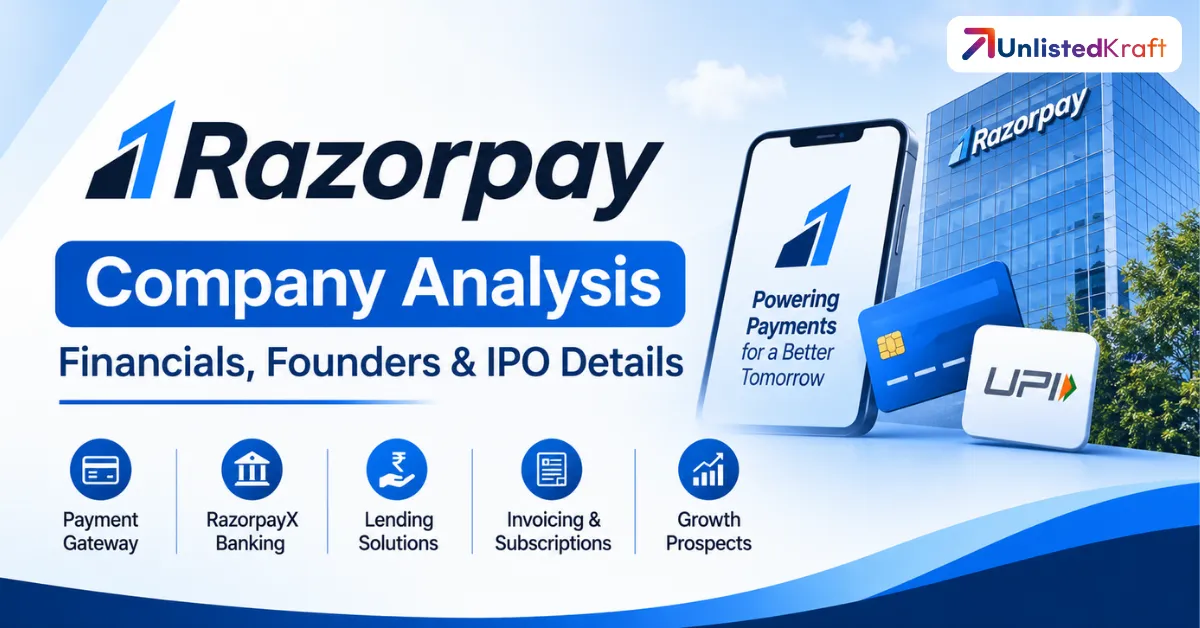
Razorpay Software Ltd is a leading Bengaluru-based Indian fintech company. It was founded in 2014 by Harshil Mathur and Shashank Kumar. It offers an integrated, API-driven payments platform and business banking services for enterprises. Razorpay’s suite includes a Payment Gateway (accepting cards, netbanking, UPI, wallets) and Payment Aggregation, plus RazorpayX Banking (business current accounts, payouts, corporate credit cards, payroll automation).
The platform also provides tools for invoicing, subscriptions, marketplace payments, and lending (working capital loans). The company serves a broad range of clients (from startups to large enterprises) across India. Razorpay is backed by top global investors (Y Combinator, Sequoia, Tiger Global, etc.) with over $740M raised to date. The company attained unicorn status in 2020 and got converted to a public company ahead of a planned IPO. Razorpay received SEBI’s observations in early November 2026 for its confidentially filed DRHP for an estimated ₹5000-6000 crore IPO.
Key Financial Highlights (FY 2024-25)
The table below shows the consolidated financial highlights of the company as of March 31, 2025:
| Particulars | FY 2024-25 (₹) |
| Revenue from Operations | 3,783.00 |
| Profit Before Tax | -1,209.00 |
| Profit After Tax | -1,206.00 |
| Earnings Per Share (₹) | -40.48 |
Company Overview
Razorpay Software Limited’s mission is to make online payments “fast, affordable and secure” for businesses. Its platform enables merchants, e-commerce sites, and other organizations to accept and disburse payments seamlessly (cards, netbanking, UPI, wallets). Beyond payments, RazorpayX offers fully functional business bank accounts, automated vendor payouts, payroll processing, and a corporate credit card.
Here are a few of the key facts about the company:
| Particulars | Details |
| Company Name | Razorpay Software Limited |
| Former Name | Razorpay Software Private Limited |
| Year of Incorporation | 2013 |
| Year of Business Establishment | 2014 |
| Company Type | Public Limited Company |
| Industry | Fintech / Financial Technology |
| Sector | Digital Payments and Financial Services |
| Headquarters | Bengaluru, Karnataka, India |
| Founders | Harshil Mathur and Shashank Kumar |
| CEO | Harshil Mathur |
| Managing Director | Shashank Kumar |
| Core Business | Digital payment processing and financial technology solutions for businesses |
| Key Products | Razorpay Payments, RazorpayX, Payment Links, Subscriptions, Invoices, and other business payment solutions |
| Business Model | B2B financial technology platform |
| Target Customers | Startups, MSMEs, enterprises, online merchants, and businesses |
| IPO Status | SEBI approval reported on November 3, 2026 |
Company’s Promoters
Razorpay has two promoters, Harshil Mathur and Shashank Kumar, who studied together at IIT Roorkee and later joined hands to address the challenges faced by Indian businesses.
Harshil Mathur
- Leadership role: He is the Co-founder and Chief Executive Officer of Razorpay
- Personal background: Harshil Mathur is from Jaipur, Rajasthan. He completed his engineering education at the Indian Institute of Technology (IIT), Roorkee.
- Educational qualification: He completed his graduation in 2013 with a degree in Mechanical Engineering.
- Early professional experience: After graduating, he worked with Schlumberger, an international oilfield services company, as a wireline field engineer.
- Founding of Razorpay: He co-founded Razorpay in 2014 and initially helped establish the business in Jaipur before its expansion.
Shashank Kumar
- Leadership role: Co-founder and Managing Director, Razorpay
- Personal background: Shashank Kumar grew up in Patna, Bihar. His interest in technology and programming developed at an early age.
- Educational qualification: He graduated from the Indian Institute of Technology (IIT), Roorkee, where he developed a strong technical foundation.
- Early professional experience: After completing his graduation, he worked as a Software Development Engineer at Microsoft in the United States.
- Association with Harshil Mathur: Shashank and Harshil met at IIT Roorkee and collaborated on several technical projects during their college years, including activities associated with the institute's software development community.
- Founding of Razorpay: He left his role at Microsoft and co-founded Razorpay with Harshil Mathur in 2014 to simplify online payments for startups and small businesses.
History and Evolution
Over the years, the company Razorpay Software has gone through the following milestones:
| Year | Key milestone |
| 2013 | Founding and early vision |
| 2014 | Early growth and Y Combinator |
| 2015 | Launch of payment gateway |
| 2018 | Moved towards a broader fintech platform |
| 2019 | Introduction of RazorpayX |
| 2020 | Accelerated digital adoption |
| 2021 | Achievement of unicorn status |
| 2022 | Diversification of fintech offerings |
| 2026 | Preparation for a potential public listing |
2013: Founding and Early Vision
Razorpay was founded in 2013 and established with the objective of addressing the challenges businesses faced while accepting digital payments in India. Its founders set out to make online payment infrastructure simpler and more accessible.
2014: Early growth and Y Combinator
Razorpay's association with Y Combinator supported its early development and helped the company refine its business model. This phase laid the foundation for its expansion in India's growing digital payments market.
2015: Launch of payment gateway
The launch of its payment gateway established Razorpay's core business of enabling online payment acceptance. It helped businesses collect payments through multiple digital payment methods using a single platform.
2018: Move towards a broader fintech platform
The company began extending its focus beyond basic payment processing. This reflected its ambition to support more aspects of business financial operations.
2019: Introduction of RazorpayX
With RazorpayX, the company expanded into business banking and financial workflow solutions. The offering enabled businesses to manage activities such as payouts and other financial operations through technology-led services.
2020: Accelerated digital adoption
The growing shift towards online commerce and digital transactions increased the relevance of Razorpay's services. The company continued expanding its product capabilities and serving businesses across sectors.
2021: Achievement of unicorn status
Razorpay attained unicorn status following a major funding round, reflecting investor confidence in its business model and growth potential. The milestone strengthened its position among India's leading fintech companies.
2022: Diversification of fintech offerings
Razorpay continued broadening its suite of business payment and financial technology solutions. Its focus increasingly covered payment acceptance, payouts, subscriptions, and other business-finance requirements.
2026: Preparation for a potential public listing
Razorpay's reported IPO preparations brought its growth, financial performance, and corporate structure into greater focus. A potential listing could mark an important transition from a privately held fintech company to a publicly traded business.
Company’s Shareholding Structure
The company’s current shareholding structure as of November 2026 is as follows:
| Shareholder | Shareholding % |
| Razorpay Inc (USA) – Parent company | 100.00% |
Board of Directors
Based on company disclosures, Razorpay Software Limited’s board of directors is as follows:
| Name | Designation |
| Shashank Kumar | Managing Director |
| Harshil Mathur | Director / Whole-time Director (CEO) |
| Arif Khan | Director |
| Shilpa Mankar Ahluwalia | Independent / Additional Director |
| Ira Gupta | Independent / Additional Director |
| Subramaniam Somasundaram | Additional / Director |
Note: Board composition is subject to change. Readers are advised to verify the latest status on the MCA portal or official company filings.
Products and Services
The company has a broad range of products and services including the following:
- Payment Gateway & Aggregation: Comprehensive suite to accept online payments (credit/debit cards, netbanking, UPI, wallets) and aggregate them into a single bank account. Supports payment links, hosted pages, QR codes, POS machines, and subscription billing.
- RazorpayX: The company has fully-featured current accounts for businesses, automated vendor payouts, and employee payroll. Also offers corporate credit cards and expense management.
- Financial Management & Invoicing: Tools for marketplaces and platforms to manage collections, automate transfers, handle split payments, and recurring invoices. Businesses can monitor cash flows, reconcile payments, and obtain real-time settlement reports.
- Lending & Working Capital: Through Razorpay Capital, the firm provides loans and credit lines to customers and vendors on the platform, leveraging transaction data to underwrite credit.
- Developer Tools & Integrations: API and SDK infrastructure for easy integration with e-commerce platforms, CRMs, and ERPs. Over 30 third-party integrations supported. Developer documentation is publicly available for custom solutions.
Peer Comparison
Razorpay is generally compared with its key competitors, Cashfree Payments and PayU (India). Here is a brief overview of how the three companies compare with each other:
| Parameter | Razorpay | Cashfree Payments | PayU (India) |
| Founded | 2013 | 2015 | 2014 (as PayU India) |
| Primary Focus | Full-stack payments + Banking (RazorpayX) + Lending | Payments + Payouts + Verification | Payments + Credit (LazyPay) + Enterprise |
| Total Funding Raised | ~$740–830M | ~$117M | Parent-backed; limited external VC |
| Key Investors | Peak XV, Tiger Global, GIC, Lone Pine, TCV | Krafton, Apis Partners, Y Combinator, SBI | Prosus / Naspers (parent) |
| Strengths | Best developer experience, subscriptions, broad product suite, brand among startups | Fast payouts/settlements, competitive pricing, strong in marketplaces | Strong enterprise relationships, EMI options, international depth |
| Market Perception | Market leader in online payment gateway for mid-market/startups | Strong #2 pure-play gateway | Established player with large merchant base |
Note: The funding details shown above are compiled from publicly available sources and are for indicative purposes only. Amounts, valuations, and investor lists may vary slightly across sources and are subject to change.
Financial Overview
The financial overview given below reflects the key financial figures of the company’s profitability and Balance Sheet.
Financial Performance
| Particulars | FY 2024-25 (₹ Crore) | FY 2023-24 (₹ Crore) |
| Revenue from Operations | 3,783.00 | 2,296.00 |
| EBITDA | -267.00 | -469.00 |
| Operating Profit Margin (%) | -7.06% | -20.43% |
| Profit Before Tax (PBT) | -1,209.00 | -1,160.00 |
| Profit After Tax (PAT) | -1,206.00 | -1,141.00 |
| Earnings Per Share (EPS) (₹) | -40.48 | -1,573.79 |
Key Financial Insights:
- Razorpay's revenue increased by approximately 65% YoY, rising from ₹2,296 crore in FY24 to ₹3,783 crore in FY25.
- EBITDA loss narrowed to ₹267 crore in FY25 from ₹469 crore in FY24, indicating an improvement in operating performance.
- Operating profit margin improved from -20.43% in FY24 to -7.06% in FY25.
- The FY25 loss was significantly influenced by one-time restructuring and tax-related expenses.
- Gross profit increased by approximately 41%, from ₹906 crore in FY24 to ₹1,277 crore in FY25.
Balance Sheet Snapshot
| Particulars | FY 2024-25 (₹ Crore) | FY 2023-24 (₹ Crore) |
| Non-Current Assets | 514.30 | 230.90 |
| Current Assets | 4,789.60 | 2,284.30 |
| Total Assets | 5,303.90 | 2,515.20 |
| Total Equity | 2,388.50 | 753.70 |
| Non-Current Liabilities | 76.20 | 53.60 |
| Current Liabilities | 2,839.20 | 1,708.00 |
| Total Equity & Liabilities | 5,303.90 | 2,515.30 |
Balance Sheet Insights:
- Total assets increased from ₹2,515.32 crore in FY24 to ₹5,303.90 crore in FY25.
- Current assets increased from ₹2,284.34 crore to ₹4,789.60 crore, registering growth of approximately 110%.
- Non-current assets increased from ₹230.98 crore to approximately ₹514.30 crore.
- Total equity increased from ₹753.70 crore to ₹2,388.50 crore.
- Current liabilities increased from approximately ₹1,708 crore to ₹2,839.20 crore during FY25.
Note: The financial information presented above has been compiled from publicly available sources, and figures have been presented for informational purposes. Certain figures may be rounded or derived from publicly reported financial data. You are advised to verify the information against the company's audited financial statements before making any investment decisions.
Key Business Strengths
The key business strengths of the company are as follows:
- Diversified Fintech Platform: Razorpay offers a comprehensive suite (payments, banking, lending, payouts) on one platform, driving strong customer stickiness.
- High Growth & Scale: 65% YoY revenue growth in FY25, and a large transaction volume (~$180 billion annualized TPV) underpin network effects.
- Investor Backing: Well-funded by marquee investors (Sequoia, Tiger Global, Peak XV, etc.) with >$740M raised, providing resources for expansion.
- Regulatory License: Authorized by RBI as a Payment Aggregator (Dec 2023) and by IFSCA at GIFT City (2026), enabling full-scale domestic and cross-border services.
- Profitable Core Business: The core payments gateway business is now EBITDA-positive, supporting cash flows while newer lines scale.
- Innovation & Tech Focus: Continuous product launches (e.g., APIs, automation tools, ChatGPT-based marketing with OpenAI, and investment in AI-driven offerings bode well for differentiation.
- Breadth of Clients: Serving “millions of businesses” from SMBs to large corporates. Razorpay benefits from network scale and word-of-mouth growth in India’s booming digital economy.
Future Growth Outlook
The company has the following future growth areas:
- IPO Capital & Visibility: The planned IPO (targeting ~₹5–6k Cr in FY27) at a ~$5B valuation will raise capital for R&D, acquisitions, or marketing, and increase public visibility.
- AI and Product Expansion: Management intends to invest in “AI-first products, financial infrastructure, and new verticals”. This could lead to enhanced offerings (e.g., AI-driven risk models, analytics) and entry into adjacent fintech areas.
- International Expansion: With GIFT City operations and prior SE Asia steps, Razorpay is poised to capture cross-border e-commerce and diaspora payment flows.
- Fintech Ecosystem Integration: As Razorpay deepens its current-account and lending services, it may add more financial services (insurance disbursements, wealth tech) to boost wallet share per customer.
- Digital Payments Growth: India’s shift toward digital transactions (UPI, e-commerce, B2B payments) provides a favorable backdrop; Razorpay’s early mover advantage could yield ongoing volume growth.
Key Business Challenges
The company works in a dynamic financial services industry and faces several challenges, including:
- Profitability Path: Razorpay has incurred large losses (₹1,209 Cr in FY25) due to one-time costs. Achieving sustainable profitability will require careful cost control and scaling high-margin services.
- Intense Competition: The fintech/payments space in India is crowded. Major rivals include Paytm, PhonePe, PayU, Cashfree, Pine Labs, etc. Maintaining technological edge and market share against well-funded competitors will be challenging.
- Regulatory Dependence: Operations are sensitive to regulatory approvals. For example, RBI had halted Razorpay’s merchant onboarding for months until its PA license was finalized. Future regulatory changes (RBI guidelines, foreign investment rules) could impact growth.
- Capital Intensity: Rapid growth demands significant working capital (as seen in its large current liabilities). Managing cash conversion cycles and funding needs without excessive borrowing is critical.
- Valuation & Market Sentiment: The volatile IPO market (as noted by delayed listing plans may pressure valuation targets. The company may need to balance growth with near-term financial discipline to satisfy public investors.
Recent Market Updates
According to reports, on November 3, 2026, Razorpay secured SEBI approval for its proposed IPO of ₹5,000–6,000 crore, targeting a valuation of approximately $5 billion. The listing is expected in Q1 FY27, subject to market conditions. In November 2026, Razorpay also reportedly obtained its final IFSCA Payment Service Provider licence for its GIFT City arm, enabling foreign currency transactions, cross-border payments and multi-currency business accounts. These developments further strengthen investor interest in Razorpay Software Limited's unlisted shares ahead of its proposed IPO and international expansion.
Disclaimer: This company analysis is based on information from Razorpay Software Limited’s website and publicly available sources. Any future performance of the company depends on factors such as regulatory changes, market conditions, and execution risks. Investors should conduct their own independent research and consult professional advice before making any investment decisions.