One of India’s largest fintech companies, PhonePe, has received regulatory approval from the Securities and Exchange Board of India (SEBI) for its upcoming Initial Public Offering (IPO). This approval clears a major hurdle and brings the company a step closer to listing on Indian stock exchanges.
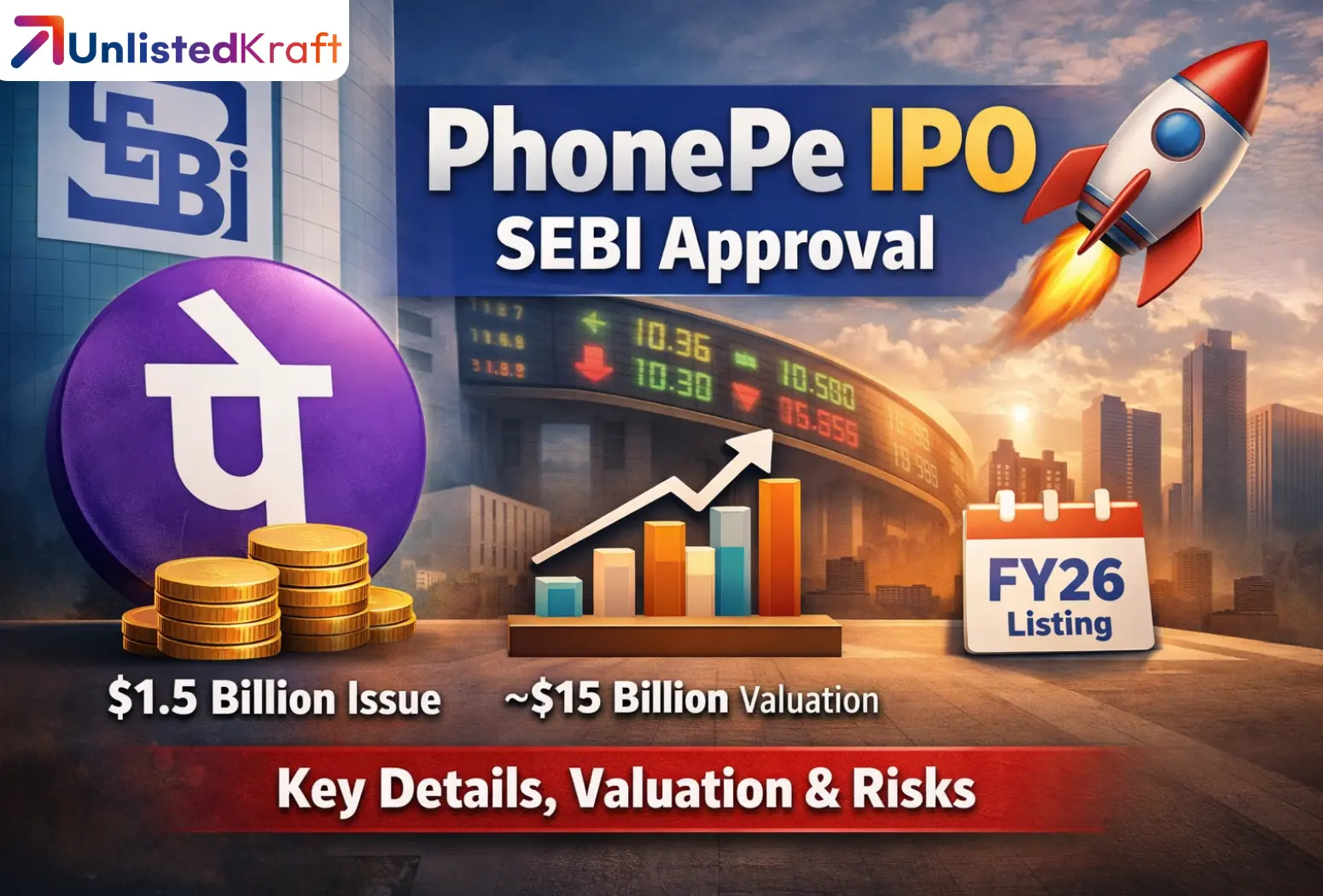
As per market reports, PhonePe may launch its IPO in the coming months, with a potential listing in FY26. The proposed IPO size is around $1.5 billion (approximately ₹12,000 crore), making it one of the most closely tracked fintech IPOs in India.
In this article, we break down the latest PhonePe IPO news, its business model, financial performance, risks, and why investors are watching this public issue closely.
PhonePe IPO Latest News & SEBI Approval Update
SEBI’s approval allows PhonePe to move forward with its IPO plans, subject to final market conditions. According to available reports, the IPO is expected to be structured primarily as an Offer for Sale (OFS), meaning existing investors may sell a portion of their holdings rather than the company issuing fresh equity.
While exact dates have not yet been announced, market expectations point toward a Q1–Q2 FY26 listing, depending on market sentiment and regulatory processes.
Kotak Mahindra Bank, JPMorgan, Citi, Morgan Stanley
Note: Details are based on publicly available information and market reports.
PhonePe Financial Performance and Growth
PhonePe has shown strong topline growth in recent years, reflecting the expansion of India’s digital payments ecosystem.
Revenue and Profitability Snapshot
Revenue (FY25): ₹7,115 crore
Revenue Growth: ~40% YoY (from ₹5,064 crore in FY24)
Net Loss (FY25): ₹1,727 crore (losses have narrowed compared to previous years)
While revenue growth remains robust, the company is yet to achieve net profitability, which remains a key factor for IPO-bound investors to evaluate.
About PhonePe
Founded in 2015 and headquartered in Bengaluru, PhonePe started as a digital payments platform and has since evolved into one of India’s largest fintech ecosystems. The company is majority-owned by Walmart, following its acquisition as part of the Flipkart investment.
Today, PhonePe serves 500+ million registered users and millions of merchants across India, making it one of the most widely used fintech apps in the country.
PhonePe Business Model Explained
PhonePe operates as a multi-product fintech platform rather than a single-service payments app.
Key Services Offered by PhonePe
Digital Payments (UPI & QR-based payments)
Insurance Distribution
Mutual Funds and Wealth Products
Credit & Lending Services
Merchant Solutions
This diversified business model helps PhonePe reduce dependence on low-margin payment transactions and build higher-margin revenue streams over time.
Why PhonePe IPO Is Important for Investors
PhonePe’s IPO is considered significant due to its scale, market leadership, and role in India’s digital economy.
Key Reasons Investors Are Tracking PhonePe IPO
Leadership in a High-Growth Market: PhonePe accounts for nearly 45% of India’s UPI transactions, giving it a dominant position in digital payments.
Backing by Global Investors: The company is supported by global names such as Walmart, Microsoft, and Tiger Global, adding credibility to its long-term vision.
Multiple Revenue Streams: Beyond payments, PhonePe earns from insurance distribution, wealth products, lending, and merchant services.
Long-Term Fintech Growth Potential: As digital adoption increases in India, fintech platforms like PhonePe may benefit from expanding financial inclusion and product penetration.
Risks Investors Should Consider Before PhonePe IPO
Despite its strengths, investors should carefully evaluate the following risks before considering the PhonePe IPO:
Regulatory Changes in the UPI Ecosystem: PhonePe’s core business depends heavily on UPI. Any changes in transaction rules, MDR policies, or NPCI regulations could affect monetisation plans.
Intense Competition in Digital Payments: The market includes strong competitors such as Google Pay and Paytm. Aggressive pricing or incentive-based strategies could pressure margins.
Profitability Yet to Be Achieved: Although losses have narrowed, PhonePe is still not profitable. Achieving sustainable profitability remains a key challenge.
Dependence on Transaction-Led Ecosystem: A significant portion of user activity comes from low-margin payment transactions, making successful monetisation of financial services critical.
Evolving Fintech Regulations: The fintech sector operates under evolving regulatory frameworks, which may increase compliance costs or limit certain business activities.
PhonePe Unlisted Shares and Pre-IPO Market
Some investors track companies like PhonePe in the unlisted or pre-IPO market before public listing. However, such investments typically involve higher risk, limited liquidity, and lower regulatory oversight compared to listed shares.
Investors considering pre-IPO opportunities should conduct thorough due diligence and understand the associated risks before participating.
Summary: Should Investors Track PhonePe IPO?
PhonePe operates in a rapidly growing digital payments and fintech market with a strong leadership position. Its scale, brand strength, and diversified business model provide a solid foundation for long-term growth.
At the same time, investors should remain mindful of competition, regulatory uncertainty, and the company’s path to profitability. The PhonePe IPO is likely to attract strong interest, but informed decision-making will be essential.
Frequently Asked Questions (FAQs)
Has PhonePe received SEBI approval for its IPO?
Yes, SEBI has approved PhonePe’s draft IPO documents.
How much does PhonePe plan to raise through the IPO?
PhonePe is expected to raise around $1.5 billion (₹12,000 crore approx.).
What is PhonePe’s estimated valuation?
The company is reportedly valued at around $15 billion.
Will PhonePe issue new shares in the IPO?
As per reports, the IPO is primarily structured as an Offer for Sale (OFS).
When is PhonePe IPO expected?
The IPO is expected in Q1–Q2 FY26, subject to market conditions.
Disclaimer
This content is provided for informational and educational purposes only and does not constitute investment advice, financial recommendations, or an offer to buy or sell securities. Investors should conduct their own research and consult qualified financial advisors before making any investment decisions. Market conditions and company fundamentals may change over time.
Author: Diwakar Singh
Diwakar Kumar Singh is a BFSI specialist and finance writer with over 7 years of hands-on experience in financial research, content creation, and analysis.
A Gold Medalist in MBA (Marketing) from IMT, he combines deep analytical skills with practical insights gained from evaluating companies, IPOs, unlisted shares, financial ratios, and investment opportunities. Diwakar has personally analysed hundreds of financial instruments and market scenarios, which he uses to break down complex topics into clear, actionable advice.
He has authored numerous in-depth finance articles, published multiple books internationally, and contributed to research publications. His work focuses on helping everyday investors and readers make better-informed financial decisions through well-researched, evidence-based explanations that are always grounded in real-world application rather than theory alone.
 amit@unlistedkraft.in
 +91-8796470040
 +91-8796470040









.webp)





 +91-9599071664
 amit@unlistedkraft.in