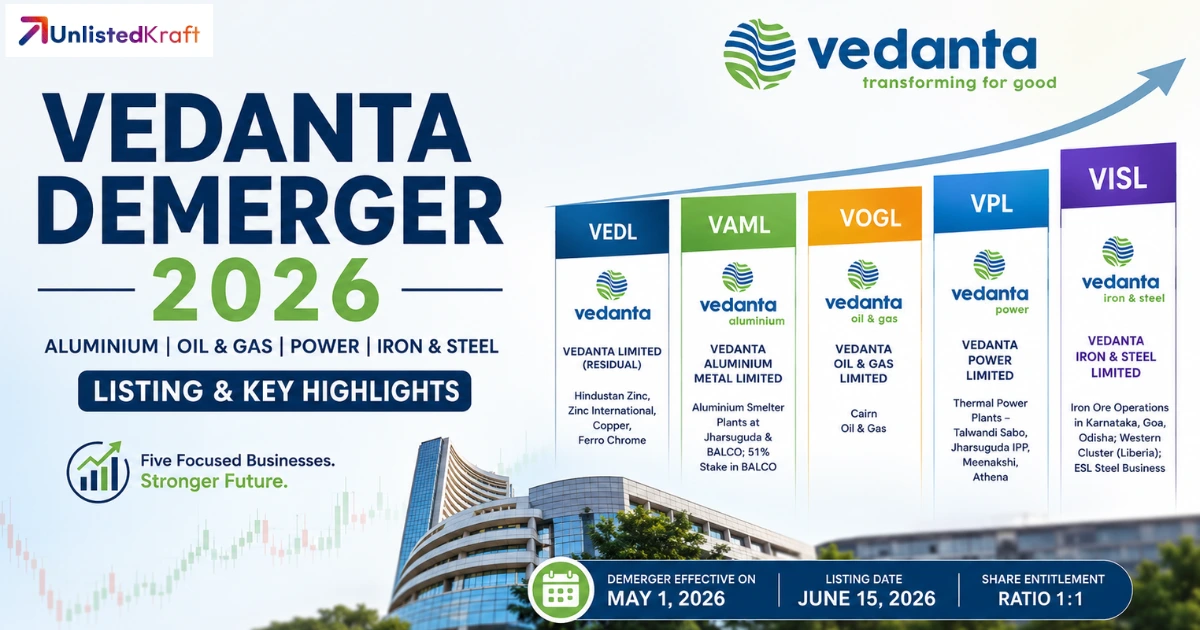
The Vedanta Group, founded and chaired by Anil Agarwal, the billionaire businessman, has finally completed its final stage of restructuring with the listing of four newly demerged companies on the NSE and BSE. The Demerger was first announced in 2023. The scheme officially became effective on May 1, 2026, with the new demerged entities’ shares hitting the stock exchanges on June 15, 2026.
The demerger transformed Vedanta Group into five focused businesses operating independently across aluminium, oil & gas, power, iron & steel, and the residual Vedanta entity. This move is aimed at improving operational focus and allowing investors to participate directly in sector-specific businesses.
This blog covers everything you need to know about the Vedanta demerger plan, the five entities, listing prices, share allotment ratios, and what it means for investors.
Vedanta Demerger: Key Details
Here are the key details of Vedanta Limited's demerger:
In September 2023, Vedanta Limited announced a plan to demerge its diversified businesses into multiple independently listed entities. The goal was to move away from a conglomerate structure, where different businesses with different capital needs and growth profiles competed under a single business group. Vedanta demerger shareholders approval was received in February 2025.
Initially, the Vedanta demerger scheme involved demerging the group into six entities. In early 2025, the Vedanta demerger plan revised to five entities. Vedanta Limited itself remains listed and will include the base metals business, including its majority stake in Hindustan Zinc Limited.
The Five Vedanta Entities Post-Demerger
Under the approved scheme, Vedanta Limited's key business verticals are now represented as five independently listed companies, where the residual Vedanta Limited retained its remaining businesses.
Iron ore operations in Karnataka, Goa, Odisha; Western Cluster Limited (Liberia); ESL Steel business
Why Did Vedanta Demerge?
Vedanta Limited demerged its businesses for the following reasons:
Better valuation of businesses: To enable each business segment to be valued independently based on its own performance and growth prospects.
Independent capital access: To allow each segment of the company to raise funds according to its specific financial requirements and expansion plans.
Focused management: To establish dedicated management teams and strategies for businesses operating in different industries.
Greater investor choice: To give shareholders and investors the option to invest in specific business verticals such as aluminium, oil & gas, power, or iron & steel.
Vedanta Demerger Share Entitlement Ratio
The Vedanta demerger was implemented through a 1:1 share entitlement ratio. In simple words, this means that for every 1 share held in Vedanta Limited on the record date, the eligible shareholders received:
1 share of Vedanta Aluminium Metal Limited
1 share of Vedanta Oil & Gas Limited
1 share of Vedanta Power Limited
1 share of Vedanta Iron & Steel Limited
This made the existing investors receive ownership in all five businesses after the demerger.
Listing Prices on June 15, 2026
All four demerged companies started trading on the stock exchanges on June 15, 2026. Before trading began, the NSE assigned a reference price of ₹121.03 per share to Vedanta Aluminium shares, Vedanta Oil & Gas shares, and Vedanta Power shares, while Vedanta Iron & Steel was assigned a reference price of ₹121.02 per share. These reference prices were used only for price discovery and do not represent the actual market trading prices of the stocks.
Here is a brief overview of the demerged entities’ estimated listing prices on 15 June 2026.
Company
NSE Listing Price
BSE Listing Price
Vedanta Aluminium Metal (VAML)
₹522
₹527
Vedanta Oil & Gas (VOGL)
₹38
₹39
Vedanta Power (VPL)
₹41.80
₹41.30
Vedanta Iron & Steel (VISL)
₹20
₹22.25
Note: Listing prices and intraday movements are subject to market conditions. The figures above reflect opening prices on the listing date (15 June 2026) as reported by exchanges and publicly available media reports.
Trading Rules on Listing Day
The four newly listed Vedanta companies were placed in the Trade-to-Trade (T2T) segment for the first 10 trading days. This means:
No intraday trading: Investors cannot buy and sell the shares on the same day. Shares purchased must be taken into the demat account before they can be sold.
5% daily price limit: The share price cannot rise or fall by more than 5% in a single trading session.
These measures are commonly applied to newly listed demerged companies to help maintain orderly trading and limit excessive price swings during the initial days of listing.
Impact of Vedanta Demerger on Investors
The Vedanta demerger has created new opportunities as well as some challenges for shareholders and investors. Here's a look at how the restructuring may impact them going forward.
Potential Benefits
Direct ownership in multiple sector-focused companies: The demerger of Vedanta Limited gave diversified ownership exposure to shareholders by holding stakes in separate aluminium, oil & gas, power, and iron & steel companies.
Improved valuation transparency: It will be comparatively easier for investors to assess the performance of each company independently.
Better capital allocation flexibility: Each company can allocate resources and investments according to its own business priorities without competing with other group segments.
Independent growth strategies for each business: Every demerged entity can pursue expansion plans, investments, and strategic initiatives for its respective business operations.
Potential for separate institutional investor interest: Sector-focused companies may attract investors and institutions that specifically prefer exposure to industries such as aluminium, energy, or steel.
Key Challenges
Commodity price Uncertainty: The performance of these businesses remains closely linked to fluctuations in commodity prices, which can impact revenues and profitability.
Sector-specific business risks: The individual exposure to challenges such as regulatory changes, demand cycles, and operational risks has increased for each segment.
Standalone debt and capital expenditure requirements: The demerged entities will need to manage their own debt obligations and fund future expansion plans independently.
Different dividend policies across entities: Each company can adopt its own dividend strategy, which may result in varying payout levels compared to the earlier combined structure.
Conclusion
The listing of demerged entities, namely Vedanta Aluminium Metal, Vedanta Oil & Gas, Vedanta Power and Vedanta Iron & Steel, is a crucial move for the potential growth of the group and its shareholders. With this demerger, followed by the listing, investors have received an opportunity to explore the key aspects of individual business verticals.
The demerger already resulted in significant value exposure, provided the long-term success of this restructuring move depends on the operational performance, growth execution and capital allocation decisions of each standalone company.
Frequently Asked Questions
When did the Vedanta demerger actually happen?
The demerger officially took effect on May 1, 2026. The newly created companies then made their stock market debut on June 15, 2026.
Who qualified to get shares in the new companies?
If you held Vedanta shares on May 1, 2026 (the Vedanta demerger record date), you were entitled to receive shares in all four of the demerged companies.
How many new shares did shareholders get?
It was a straightforward 1:1 ratio for every single Vedanta share you owned; you received one share in each of the four new companies.
What companies came out of this demerger?
Four new independent companies were created: Vedanta Aluminium Metal Limited, Vedanta Oil & Gas Limited, Vedanta Power Limited, and Vedanta Iron & Steel Limited. The original Vedanta Limited still exists as a listed company alongside them.
What price did the new shares open at?
The opening prices were determined through a special pre-open session on listing day. Of the four, Vedanta Aluminium Metal came out with the highest valuation.
Where can these new shares be traded?
All four companies are listed on both major Indian exchanges - the NSE and the BSE.
What does the Vedanta demerger mean for shareholders?
Instead of having one company with multiple businesses bundled together, shareholders now hold separate stakes in focused, sector-specific companies. This gives more flexibility to invest in or exit whichever sectors they prefer.
What's the latest news on Vedanta Limited’s demerger?
The latest update on Vedanta’s demerger is the successful listing of all four companies on June 15, 2026.
Sources
The following publicly available sources were used to support the blog:
Moneycontrol – Vedanta Demerger Listings: Aluminium Debuts at ₹522, Oil & Gas at ₹38
Business Standard – Vedanta's Four Demerged Stocks Debut; Aluminium Shines
News18 – Vedanta Group's Four Demerged Companies Debut on Stock Exchanges
Economic Times – Vedanta Demerger Live Updates
Vedanta Resources – Official Vedanta Demerger Information Page
ICICI Direct – Vedanta Demerger Update (April 2026)
Disclaimer: The share prices, market capitalisation figures, and estimates mentioned in this blog are based on publicly available information as of June 2026 and are subject to market conditions. This is for informational purposes only and does not constitute investment advice. Readers are advised to consult professional advice before making investment decisions.
Author: Komal Bhatt
Komal Bhatt is a finance content writer at InvestKraft, specialising in well-researched articles on financial products, stock markets, and investment opportunities, with a particular focus on unlisted shares.
She holds a Master’s degree in Commerce from the University of Delhi, which gives her a solid academic foundation in finance and business. With over three years of hands-on experience in creating digital finance content, Komal has developed a clear understanding of investor needs through her work on wealth management, NISM certification programs, and market education materials.
Komal is passionate when it comes to breaking down complex financial concepts into simple, accurate and actionable insights. Her goal is to help everyday investors understand markets better and make more informed decisions based on reliable, research-backed information.
Track The
Next Big IPO
Discover upcoming IPOs before they hit the market.
 amit@unlistedkraft.in
 +91-8796470040
 +91-8796470040