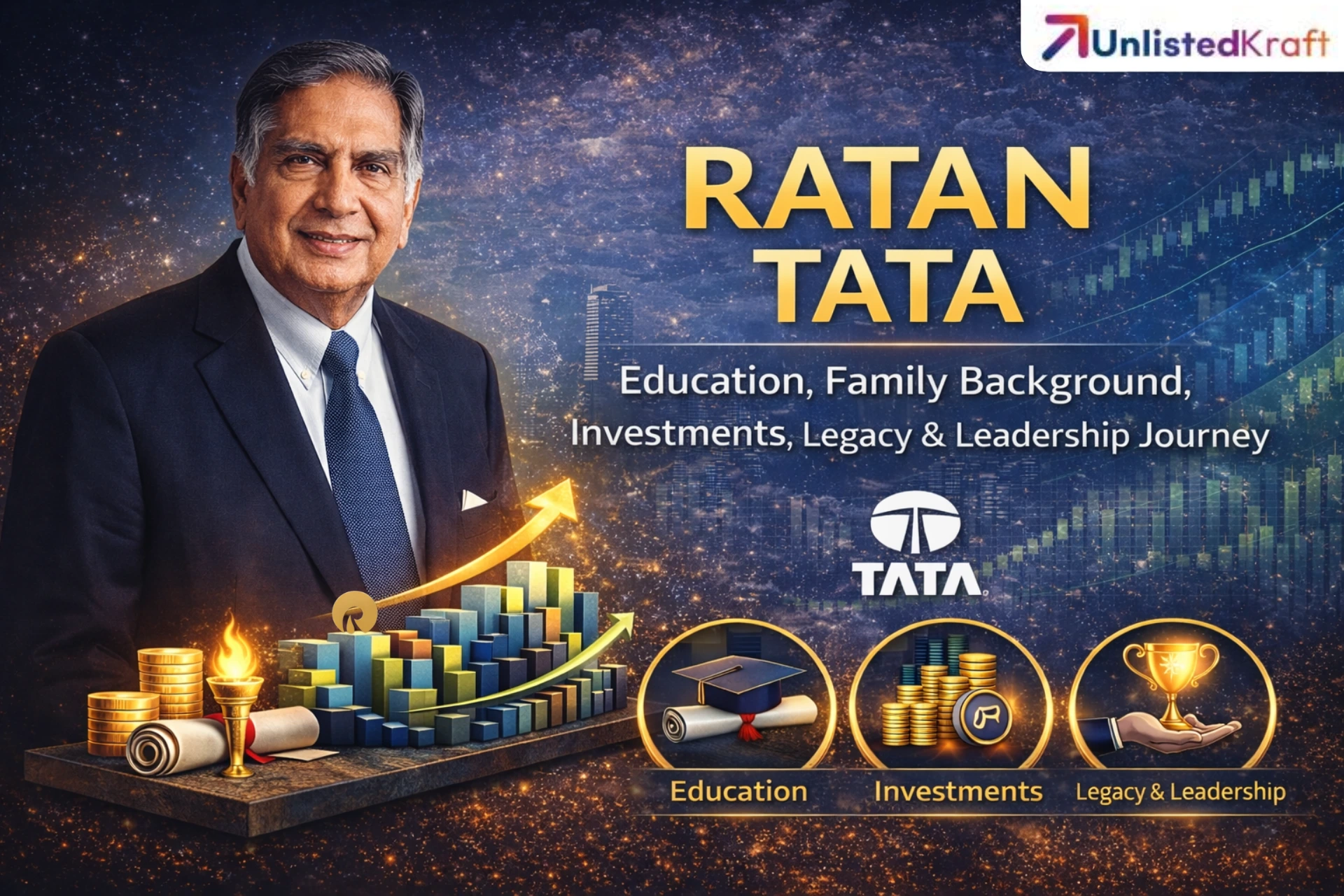
Ratan Naval Tata was a leading industrialist and best known as the former chairman of the Tata Group. He served the Tata Group as the chairman for more than 2 decades from 1991 to 2012 and was interim chairman from October 2016 to February 2017.
Throughout his professional career, he became the driving force behind transforming a homegrown conglomerate into a globally recognised enterprise.
Along with other notable achievements, he has been awarded Padma Bhushan in 2000 and Padma Vibhushan in 2008 for his noble contributions to the Indian trade and industry. His decisions were often guided not only by profitability but also by long-term societal impact - a balance that earned him deep respect across industries and generations.
Key Facts about Ratan Naval Tata
Here are a few quick facts to know about Ratan Naval Tata.
Global Expansion of Tata Group, Tata Nano, Startup Investments
Estimated net worth
Approx. $1 billion (₹3,800 crore)
Marital Status
Unmarried
Children
None
Successor at
Tata Sons
Date of Death
9 October 2024
Early Life, Education & Family Background
Ratan Tata was born on 28 December 1937 in Mumbai and was raised in a Parsi family. Ratan Tata’s early life was shaped by a personal challenge. His parents, Naval Tata and Sonoo Tata, got divorced when he was just 10 years old. But despite this, he was raised lovingly by his grandmother.
The Key Educational Background
Ratan Tata’s Education gave him great exposure to thrive in the business industry.
Schooling: He completed his schooling at Bishop Cotton School (Shimla)
Higher School: He earned a Bachelor's degree in Architecture from Cornell University, USA.
Executive Education: In 1975, he completed the Advanced Management Program from Harvard Business School (USA).
Ratan Tata’s Net Worth
At the time of Ratan Tata’s death in October 2024, his personal net worth was estimated to be around ₹3,800 crore (roughly $1 billion). While he controlled the Tata Group, a massive global business worth over $300 billion, his personal wealth was much lower than that of other famous billionaires for a few simple reasons:
Ownership by Charity: About 66% of Tata Sons is owned by charitable trusts.
Small Personal Stake: He personally owned less than 1% of the company.
His Final Will: Reportedly, he left the majority of his wealth to the Ratan Tata Endowment Foundation to continue his charity work.
Personal Assets: His estate included his home in Colaba, Mumbai, a beach house in Alibaug, and a collection of luxury cars.
Ratan Tata’s net worth dynamics show that he chose to be a trustee of wealth rather than an owner of it. He used his position to build India's industry while giving away most of what he earned.
Career Timeline of Ratan Naval Tata
Here’s a quick look at the major roles and responsibilities he held over the years.
Years
Position / Role
Organization
2012 -Until his passing
Chairman Emeritus
Tata Sons
2016 - 2017
Interim Chairman
Tata Sons
1991-2012
Chairman
Tata Group
1991-2012
Member, Prime Minister’s Council on Trade and Industry
Government of India
1991-2012
Advisory Board Member, Asia Pacific Policy
Research and Development Corporation
1977
Transferred to Empress Mills
Empress MIlls
1971
Director-in-charge
NELCO
1962
Joined Tata Sons
Tata Sons
TATA Group’s Major Acquisitions
Under Ratan Tata’s leadership, the Tata Group made the following strategic acquisitions:
The purchase of Jaguar Land Rover was initially criticised. However, it later became one of the most successful acquisitions in Indian corporate history.
These acquisitions demonstrated three core traits of Ratan Naval Tata - Strategic risk-taking, global ambition and confidence in Indian enterprises.
Ratan Tata as an Investor
Post-retirement, Ratan Tata emerged as a respected startup investor. He invested in companies such as Ola, Paytm, Zomato, Snapdeal, etc. His investment style reflected
Founder-first mindset
Long-term scalability focus
Ethical entrepreneurship
Tata Nano - A Bold Vision
Tata Nano was one of the most ambitious projects of Ratan Tata. Launched in 2008 at around ₹1 lakh, it aimed to make car ownership possible for middle-class Indian families.
Though commercially it did not meet long-term expectations, it symbolised:
Innovation for the masses
Risk-taking leadership
Customer-centric thinking
A vision of affordable mobility for every Indian family
Even today, Tata Nano is remembered as a bold experiment driven by purpose, not just profits.
Summary
Ratan Tata’s life was not just about business success - it was about building institutions, empowering entrepreneurs, and redefining ethical leadership in India. He remains a benchmark for Corporate governance, nation-first capitalism and responsible wealth creation that benefits both individuals and society.
Frequently Asked Questions
What was Ratan Tata's age when he died?
Ratan Tata's age was 86 years at the time he passed away in October 2024.
What is Ratan Tata's net worth?
Ratan Tata's net worth was estimated at around $1 billion at the time of his passing.
Who was Ratan Tata's wife?
Ratan Tata never got married. He had spoken publicly about relationships but remained unmarried throughout his life.
Did Ratan Tata have a son?
Ratan Tata had no son or children.
What was Ratan Tata's educational background?
Ratan Tata's education includes a Bachelor’s degree in Architecture from Cornell University and completion of the Advanced Management Program (AMP) at Harvard Business School.
When did Ratan Tata die?
Ratan Tata died on 9 October 2024.
How were Ratan Tata and Cyrus Mistry related?
Cyrus Mistry became Chairman of Tata Sons after Ratan Tata stepped down in 2012. But, in 2016, he was removed from the position, which later led to a major corporate dispute.
Author: Komal Bhatt
Komal Bhatt is a finance content writer at InvestKraft, specialising in well-researched articles on financial products, stock markets, and investment opportunities, with a particular focus on unlisted shares.
She holds a Master’s degree in Commerce from the University of Delhi, which gives her a solid academic foundation in finance and business. With over three years of hands-on experience in creating digital finance content, Komal has developed a clear understanding of investor needs through her work on wealth management, NISM certification programs, and market education materials.
Komal is passionate when it comes to breaking down complex financial concepts into simple, accurate and actionable insights. Her goal is to help everyday investors understand markets better and make more informed decisions based on reliable, research-backed information.
 amit@unlistedkraft.in
 +91-8796470040
 +91-8796470040








 +91-9599071664
 amit@unlistedkraft.in